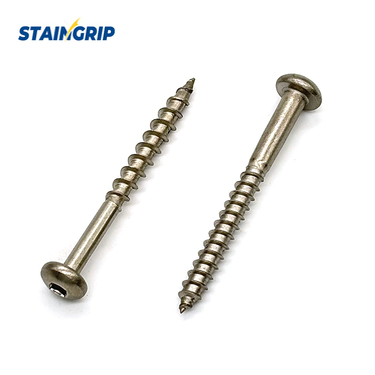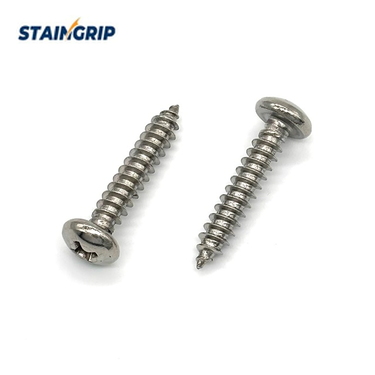
304 / 316 stainless steel · Partial thread · Type 17
Stainless Steel Wafer/Truss Head Type 17 Wood Screws
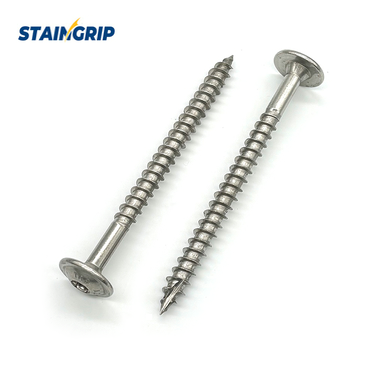
A broad wafer or truss head spreads bearing contact while an unthreaded upper shank allows the top timber member to draw against the support. The Type 17 point and Torx drive form a wood-fastening design for timber frames, pergolas and outdoor joinery.
- 304 or 316 stainless steel
- Wafer / truss head with Torx drive
- Partial thread and Type 17 wood-entry point
KEY FEATURES & PERFORMANCE
Timber pull-down.
Broad bearing.
The unthreaded section and lower thread have distinct roles. The upper member can slide along the plain shank as the lower thread engages the receiving timber. Head bearing, shank position and embedment are selected around the actual wood-to-wood joint.
- 01
304 and 316 stainless steel
304 provides a general-use stainless steel choice; 316 is considered for salt exposure or chemically demanding environments. Treated timber, moisture and nearby metals remain part of the selection.
- 02
Broad wafer / truss head
The wide, shallow head distributes bearing contact across the upper timber. Its integrated washer-like face reduces the need for a separate flat bearing washer, subject to the specified joint detail.
- 03
Type 17 cutting point
The notched point helps cut timber fibres and clear chips as the fixing starts. Species, density, moisture and edge distance still determine pilot-hole needs and the risk of splitting.
- 04
Plain shank for joint pull-down
The unthreaded upper section allows the top member to move towards the support as the lower thread advances. Its length must suit the upper member so the joint closes as intended.
- 05
Lower thread in receiving timber
The threaded section anchors into the receiving member. Embedment, edge spacing and timber properties must be checked against the required connection loads rather than inferred from the heavy-duty description.
- 06
Torx driving engagement
The star recess gives the matching bit multiple contact faces for torque transfer. Straight tool access, correct bit fit and a controlled seating depth help protect the recess and wood surface.
TECHNICAL SPECIFICATIONS
Size & Configuration Overview
The listed product and series details guide selection of an order configuration.
| Material options | 304 / 316 stainless steel |
|---|---|
| Head style | Wafer / truss flange head with broad bearing face |
| Drive | Torx / star drive |
| Shank arrangement | Partial / half thread with an unthreaded upper section |
| Point | Type 17 notched wood-entry point |
| Listed diameters | #8, #10, #12 and #14 |
| Listed length range | 1-8 in (approximately 25-203 mm) |
| Connection type | Timber-to-timber frames, joinery and substructures |
| Selection dimensions | Upper-member thickness, plain-shank length and timber embedment |
| Custom production | Head, drive, dimensions, tolerances and finish by agreed specification |
Published ranges are not a stock matrix. The final grade, diameter, length, point, thread, head and finish combination is agreed in the quotation and defined by the ordered drawing.
APPLICATIONS & CONNECTION PLANNING
Connections & Selection Details
Timber frames & pergolas
The upper timber thickness determines the required plain-shank position, while the receiving member sets thread embedment. Structural use needs the fixing schedule, timber properties and data for the actual connection.
Log structures
Log construction brings variable surfaces and movement across the joint. Head bearing, member contact and available embedment must suit the geometry; pilot-hole preparation depends on the timber and edge conditions.
Deck substructures & joinery
Outdoor timber substructures and joinery require review of moisture, species and preservative treatment. Identify ACQ-treated timber and coastal or chemical exposure when choosing 304 or 316 and any special finish.
Use the fixing schedule and data for the selected fastener and joint. Published applications do not establish a rated load or universal installation method.
COATING SOLUTIONS
Match the Finish
to the Timber
Passivation, head colour matching and specialty finishes can be reviewed through the custom-order process. No specific Ruspert configuration or salt-spray rating is established for this wood screw by its product listing.
Identify timber treatment, moisture exposure and adjacent metals before choosing a surface treatment. For ACQ-treated wood or salt-exposed locations, assess the stainless steel grade and requested finish together. An agreed finish specification is part of the order, not a substitute for connection design.
Explore Coating Solutions →CUSTOMER QUESTIONS
Product, OEM & Packaging Q&A
Product selection, custom production and packing details for this screw design.
Product
Why is part of the shank unthreaded?
The plain upper section lets the top timber member slide towards the support as the lower thread advances. Its position must match the upper-member thickness for the intended pull-down action.
Product
Does Type 17 remove every pilot-hole requirement?
No. The cutting point assists entry and chip clearance, but dense timber, end grain and small edge distances may still require preparation. Follow the joint detail and guidance for the chosen configuration.
Product
Can the heavy-duty description establish a load rating?
No. Required loads need supporting data for the screw, timber species, embedment and connection geometry. The wide head and partial thread describe the design, not a numerical capacity.
OEM
Can you customise the head, drive and dimensions?
We can review head logos, head shapes, drive details, dimensions and tolerances against your drawing or specified ASME reference. The agreed design defines the production requirement.
OEM
Can you match a colour or surface treatment?
Head colour matching, passivation and specialty finishes can be reviewed for the selected material and application. Provide the colour reference and exposure conditions with your brief.
OEM
Are samples available before production?
Custom samples and initial inspection reports can be arranged before full production. The sample quantity, inspection scope and approval criteria are agreed during development.
Packaging
Which packing formats can we choose?
Small polybags, inner boxes and industrial bulk packing are available formats. Specify the quantity per pack and handling requirements so the packing specification can be agreed.
Packaging
Can inner and outer packs carry our brand?
Yes. Inner and outer box designs, printed logos and brand artwork can be prepared from your supplied files. Artwork and pack dimensions are reviewed before production.
Packaging
Can you include our barcodes and shipping marks?
Private labels, UPC / EAN barcodes, part numbers and shipping marks can be included in the packaging brief. Supply the required data and label layout for checking.
ORDER SUPPORT
Documents, Production & Delivery
Material & inspection records
Material test reports and mill certificates can be requested for the order. Agree the required documents, inspection scope and batch traceability against the selected material before production.
Stock & custom production
Available stock and factory production follow different order routes. Stock availability is checked for the requested configuration; bulk and custom orders are scheduled to the agreed specification and quantity. Timing is established in the quotation.
International shipping
FOB, CIF and DDP arrangements can be discussed for the destination. Shipment tracking supports the agreed transport route. Route availability, DDP coverage and delivery terms are established with the order.
Standards & Material References
| Dimensional references | ASME B18.6.3 / ASME B18.2.1 / ANSI |
|---|---|
| Material / physical references | ASTM F593 (Group 1: 304/305; Group 2: 316) / ASTM A240 |
Confirm the edition, component scope and inspection documents. ANSI needs a specific reference; ASTM F593 group references do not add 305 as a sale option or certify the complete screw.
RELATED DESIGNS