
Timber assemblies
Garden structures, screens and timber substructures. Match the screw to the joint and required embedment.
Wafer / flange · Type 17
STAINLESS STEEL · WOOD FASTENING
Choose a stainless steel wood screw around the timber, the joint and the environment. Get the head, thread and point working together for the connection you need.

01 / APPLICATIONS
Wood density, surface finish and the way the joint transfers force all affect the fastening choice.
Garden structures, screens and timber substructures. Match the screw to the joint and required embedment.
Choose a visible or recessed head to suit the finish. Check pilot-hole requirements in dense hardwood.
Brackets, hardware and wood-based panels need a head that seats correctly against the upper member.
WHY THE MATERIAL MATTERS
In demanding timber connections, moisture and treatment chemicals can be as important as the load. Stainless steel deserves consideration when corrosion could damage the fastening or make a finished joint difficult to maintain.
Compare the grade and the protection system. Here, carbon steel includes both uncoated screws and screws protected by zinc or another coating. Their performance is not identical; compare the specified products in the actual service environment.
| Selection factor | Stainless steel screws | Carbon steel screws |
|---|---|---|
| How corrosion protection works[1][2] | Chromium in the alloy forms a thin passive film. It can reform after a surface scratch when oxygen is available; this does not repair lost metal or make every grade immune to corrosion. | Bare carbon steel has no equivalent chromium-rich film. Zinc plating, hot-dip galvanizing and other coatings add protection, but these are different systems with different exposure limits. |
| Wet service and salt exposure[3][4] | 304/305 and 316 offer different corrosion resistance. 316 generally resists chloride attack better, while trapped moisture, salt deposits and crevices still affect suitability. | Specify the actual coating, its thickness and the environment it is approved for. A generic description such as zinc plated or exterior screw is not enough for a demanding connection. |
| Damage during installation[1][7] | Corrosion resistance comes from the alloy, rather than only an applied barrier. Keep the surface clean and choose the grade for the conditions; a passive film cannot overcome an unsuitable environment. | Damage or wear can reduce the protection of a coating. Zinc can also protect sacrificially, so a small scratch does not mean immediate failure; the remaining coating and exposure both matter. |
| Strength and driving performance[5][2] | The alloy name is not a load rating. Check the exact screw's shear, withdrawal, pull-through and installation requirements. Stainless is not automatically a stronger substitute for a specified carbon-steel screw. | Heat-treated carbon-steel designs can provide high strength and a hard cutting point. Those benefits must be assessed separately from corrosion protection; verify the selected fastener and complete connection. |
| Maintenance and total project cost[6] | A suitable grade can reduce corrosion-related replacement needs. This matters where opening a finished assembly or gaining access costs more than the screws. Inspection and appropriate cleaning may still be needed. | A correctly specified coated screw can be a practical choice where exposure and maintenance suit the system. Compare purchase, installation, inspection and replacement costs, rather than assuming one material always costs less overall. |
Identify the preservative, treatment level and expected wetting. Compare stainless with a coating specifically accepted for that treatment. The treatment supplier's guidance and the connecting hardware both matter; a timber label alone does not settle the choice.
Salt exposure gives a stronger reason to assess 316 instead of treating all stainless as equivalent. Review sheltered joints that can retain deposits, and allow for drainage and access to inspect the connection.
For concealed fittings or finished joinery, include the work needed to reach and replace a corroded fastener. A suitable stainless grade can be valuable here, while structural capacity still needs evidence for the actual timber and screw.
These references explain general material behaviour. Confirm application suitability and performance for the selected StainGrip screw and connection.
02 / HOW TO CHOOSE
Work through four decisions, then compare the products that match.
Compare specificationsRecord species, density, treatment and the two parts being joined.
Hardwood, softwood and wood-based panels respond differently to driving and splitting forces.
Consider 304 for suitable general exposure; assess 316 where chlorides or more aggressive conditions are present.
The environment and timber treatment determine corrosion requirements, not the screw’s appearance.
Select a bearing head for fittings or a suitable recessed head for a flush finish. Check full versus partial thread.
The head seats against the top member; the thread engages the receiving timber. Both details matter.
Confirm upper-member thickness, effective thread embedment, edge distances and pilot holes.
A longer screw is not automatically a stronger joint. Geometry and installation determine how it works.
03 / HEAD · DRIVE · POINT · THREAD
Read the screw in four parts. Each part answers a different question about the connection.

A flat top with a curved underside that blends into the shank. Match the seating depth and pilot-hole preparation to the timber and the selected screw.
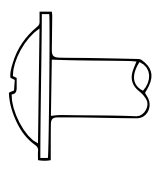
A broad integral flange increases the bearing area. Match it to the upper member and available clearance.
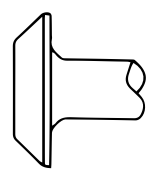
A broad, shallow head for suitable surface-mounted connections. Check the bearing diameter on the product drawing.
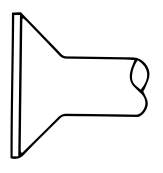
A tapered seating form for a prepared recessed connection. A separate washer, where specified, is an additional part.
Compare the bearing surface, visible finish and the prepared seat.
| Feature | How it works | Selection and product fit |
|---|---|---|
| Flat / countersunk; optional underhead nibs | A tapered underside fits a compatible recessed seat. Underhead nibs add cutting detail during seating; they do not identify the thread form. | Specify the head diameter, included angle and nib pattern. Confirm the upper material permits countersinking and the selected product carries these features. |
| Pan, flange and wafer heads | These forms provide a bearing face above the surface. A broad flange or wafer spreads contact over a larger area than a compact head. | Match the contact face to the fitting or board, available clearance and specified pull-through resistance. Use the exact head diameter on the drawing. |
| Bugle head | The underside has a curved transition into the shank. This differs from a straight countersunk cone and changes how the head seats. | Bugle Head Type 17 Wood Screws is a listed bugle-head wood design. Specify the drive, timber, pilot hole and seating depth; the name alone does not establish load capacity. |
| Oval / raised countersunk head — enquiry reference | A raised crown remains visible above a tapered seating surface. This profile can be specified when a recessed seat with a domed finish is wanted. | Not listed among the current seven wood products. Send a drawing or sample to review availability, head dimensions and a suitable drive configuration. |
| Hex washer head — connection-dependent | An external hex accepts a nut setter; an integral flange provides the bearing surface. An additional sealing washer is a separate component. | For timber-supported roofing, request a wood-entry configuration. A similar head on a self-drilling screw does not make its metal point interchangeable with a wood point. |
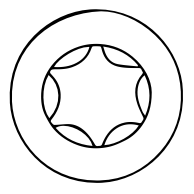
Use the exact bit size specified for the screw. The six-lobe recess needs full driver engagement.

A square recess for a matching square bit. Confirm the selected product’s bit size before installation.
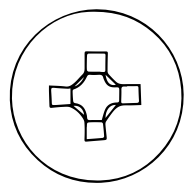
Use a correctly sized Phillips bit and keep it aligned with the recess during driving.
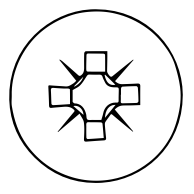
The additional marks distinguish this recess from Phillips. Confirm the drive version for the selected product and use a matching Pozi bit.
Choose the recess and the matching bit as one specification.
| Feature | How it works | Selection and product fit |
|---|---|---|
| Torx / six-lobe — TX10–TX30 enquiry range | The six-lobe recess requires the matching bit size and full engagement. Head diameter and recess depth limit which drive can be specified. | TX10–TX30 is a range to discuss when enquiring, not a promise of every size. Selected deck products currently list T20 / T25. |
| Pozidriv — PZ1–PZ3 enquiry range | Pozi and Phillips have different recess geometries. Identify the recess from the ordered drawing and use a matching driver rather than treating them as interchangeable. | PZ1–PZ3 can be included in an enquiry. The current product comparison does not confirm this complete range or a Pozi version of every head. |
| Phillips — PH1–PH3 enquiry range | A Phillips recess needs a correctly sized cross-head bit, kept aligned while driving. The specified screw size does not by itself determine the bit size. | PH1–PH3 is an enquiry range. Phillips configurations appear in the catalogue, but the exact size and availability must be agreed for the chosen model. |
| Square — SQ1–SQ3 enquiry range | A square recess uses the matching square bit. Check recess size and driver fit before production installation, especially when working with a small trim head. | SQ1–SQ3 is an enquiry range; existing listings include #1 / #2 square options and Square Drive Flat Head Deck Screws specifies SQ2. Confirm each model rather than extending these entries. |
TX10–TX30, PZ1–PZ3, PH1–PH3 and SQ1–SQ3 are bit-size ranges to discuss in an enquiry. Existing listings include T20 / T25 and #1 / #2 square options; confirm each ordered head and drive.

A pointed wood-screw profile. Timber density, diameter and edge distance still determine pilot-hole needs. For a Type 17 design, confirm the notched tip on its own drawing.
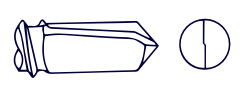
Use this distinction when the receiving member is metal. Select a self-drilling screw with the appropriate drilling range; a wood point does a different job.
Identify the receiving material before deciding whether a pilot or clearance hole is needed.
| Feature | How it works | Selection and product fit |
|---|---|---|
| Sharp / gimlet point | A tapered sharp point locates the screw in timber. It begins penetration but does not establish a metal-drilling capacity or remove every pilot-hole requirement. | Choose the pilot hole from the timber density, screw diameter, edge distance and product instructions. Trial the intended connection where splitting or finish is critical. |
| Type 17 notched point | A cut or notch near the tip creates a cutting and chip-clearance feature for the intended wood connection. Confirm the actual notch on the drawing. | Bugle Head Type 17 Wood Screws and Type 17 Chipboard Screws with Washer list Type 17 wood points. Hard timber, board ends or sensitive joints may still require pilot holes; this is not a rated steel drill point. |
| Drill point — metal receiver | A metal drill point combines cutting edges and flutes. Its function is different from that of a sharp or notched timber-entry point. | If the receiving member is steel or aluminium, use the self-drilling selection route and confirm the exact metal grade, thickness and approved point configuration. |

A widely spaced thread profile for timber engagement. Select diameter, embedment and full or partial thread for the actual joint.
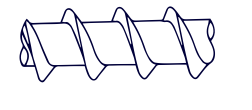
A deep thread profile for suitable wood-based board connections. Match the exact screw, head and installation method to the panel.
Select the thread for the receiving material, and check where it engages within the joint.
| Feature | How it works | Selection and product fit |
|---|---|---|
| Coarse wood / particle-board thread | A deep, widely spaced thread engages the receiving timber or wood-based board. The usable engagement length is distinct from the screw’s total length. | Specify the material, thickness, required embedment and edge distances. Select a tested screw and connection detail when the joint carries a design load. |
| Partial thread and plain upper shank | The plain shank can let the upper component move towards the receiving member during tightening. This depends on the unthreaded length matching the joint. | Square Drive Pan Head Wood Screws, Bugle Head Type 17 Wood Screws and Phillips Pan Head Wood Screws list partial threads. Check the board thickness and embedment; a partially threaded screw does not automatically clamp every assembly correctly. |
| Serrated thread — separate from head nibs | Thread serrations are notches in the thread profile that can reduce cutting resistance in a designed timber screw. Head nibs act at the seating face. | Request the precise thread drawing and installation data. A serrated-head description alone does not confirm serrated threads, and the feature does not guarantee installation without pre-drilling. |
These illustrations compare common screw geometries; they are not dimensioned product drawings. Confirm the exact head, drive, point and thread combination for the selected StainGrip product. Head & drive reference ↗ · Point & thread reference ↗
04 / MATERIAL & ENVIRONMENT
Compare stainless grades and coated carbon steel by corrosion behaviour, installation demands and the complete connection.
| Material / construction | Technical behaviour | Timber connection fit | Selection details |
|---|---|---|---|
| 304 stainless steel | An austenitic chromium-nickel steel commonly called 18/8. It balances general corrosion resistance and formability. Cold working can strengthen it; conventional heat treatment does not harden it like 410. | A common choice for outdoor joinery, furniture and timber connections with moderate exposure. Check preservative compatibility, retained moisture and the grade of connecting hardware. | Assess 316 where salt or chemical exposure is more demanding. The 304 designation does not establish a load rating or automatically certify an A2-70 property class. |
| 305 stainless steel | Higher nickel content reduces work hardening compared with 304. Good ductility and cold-forming behaviour suit fastener manufacture, but do not guarantee that a finished screw cannot break during installation. | Relevant to timber fastener selection when offered for the chosen design. The wood screws shown here list 304/316; request confirmation before specifying 305 for another configuration. | Do not infer lower driving torque or freedom from head breakage from nickel content alone. Correct bit fit, pilot-hole requirements and controlled seating still matter. |
| 316 stainless steel | Molybdenum improves resistance to chloride-driven pitting compared with 304/305. This makes 316 worth assessing for salt exposure, while crevices, deposits and concentrated chemicals can still cause corrosion. | Consider for coastal joinery, waterfront timber and wet connections exposed to salt or chemicals. Review the actual exposure and compatible fittings before selecting the screw. | Select by salt concentration, wetting, drainage and maintenance access. Distance from the coast alone is insufficient; 316 is neither a universal marine approval nor a lifetime guarantee. |
| 410 hardened stainless steel | A magnetic martensitic grade that can be hardened by heat treatment. Hardness supports cutting and driving functions, but its corrosion resistance is lower than 304/305 or 316. | Relevant where a specified screw needs a hardened cutting design, including some timber-to-metal connections. Dense hardwood can still require pilot holes; hardness alone does not settle installation. | Use product data for torque and strength rather than a generic high-torque claim. Review the exposure and finish carefully; hardened construction does not confer 300-series corrosion resistance. |
| Coated carbon steel | Heat-treated designs can offer high strength and a lower purchase cost. Corrosion performance depends on the specified coating system; zinc plating, galvanizing and proprietary multilayer finishes are not interchangeable. | Suitable designs can serve indoor and exterior timber work when their coating is approved for the exposure and wood treatment. Use the specified connection data and maintenance guidance. | Coating damage can reduce protection, although zinc can protect small exposed areas sacrificially. Compare installation, inspection and replacement costs as well as the initial screw price. |
Choose appearance, driving lubrication and corrosion protection as separate requirements. Confirm the finish on the exact screw you order.
| Finish / treatment | Purpose and application | How to specify |
|---|---|---|
| Plain / uncoated stainless | A metallic stainless surface without an added decorative or barrier coating. Corrosion selection still starts with the alloy and exposure. | Request the required surface condition on the drawing. Plain appearance alone does not specify cleaning or passivation. |
| Passivation | A controlled surface treatment used to remove free-iron contamination and support a clean passive stainless surface; it is not a paint layer. | Listed as a finish request for wood and deck ranges. Agree the process, cleanliness checks and inspection documents. |
| Painted heads | Teak, Charcoal, Cedar, Sand and White are listed examples on selected deck designs. Other colour matching can be reviewed against a sample. | Colour availability is model-specific. Confirm board reference, shade, gloss, coverage and the protective system separately. |
| Wax / lubricating finish | A specified lubricant can reduce friction during driving. Treat lubrication as an installation feature, not a substitute for a suitable corrosion-resistant alloy or coating. | Wax is a custom enquiry item, not a stated standard finish for these models. Agree coating compatibility and installation requirements before production. |
| Ruspert / protective coating | Ruspert is listed as an optional finish on selected self-drilling screws. Selected 410 deck designs list exterior protection without a universal coating system. | Specify the screw material, coating system and exposure. For a 1000-hour ASTM B117 requirement, agree the sample, acceptance criteria and test report; no family-wide 1000-hour rating is implied. |
Salt-spray hours describe a specified laboratory test. They do not by themselves predict service life outdoors. Match the coating, base metal, treated timber and neighbouring metals to the actual connection.
For load-bearing connections, confirm the design loads and evidence for the exact screw and timber assembly.
BEFORE YOU SPECIFY
Not in every timber or joint. The cut point helps with wood entry and chip clearance, but hardwood, board ends and splitting-sensitive connections may still need pilot holes.
Look at how the joint should clamp. With partial thread, the smooth shank must suit the upper-member thickness. A full-thread screw has a different engagement arrangement; confirm it against the drawing.
Timber species and treatment, joint arrangement, member thicknesses, environment, head and drive preference, diameter, length, quantity and packaging.
05 / SPECIFICATION COMPARISON
Review 7 relevant designs in the StainGrip range. Follow a product name for its full details.
Use these catalogue options to prepare your enquiry. Confirm the exact diameter × length × material combination, drilling capacity and drawing before ordering; listed options do not guarantee that every combination is available.
Compare all 9 fields · Swipe or scroll the table →
| Product design | Material | Diameter | Length | Head | Drive | Point / drill tip | Thread | Finish / Colour |
|---|---|---|---|---|---|---|---|---|
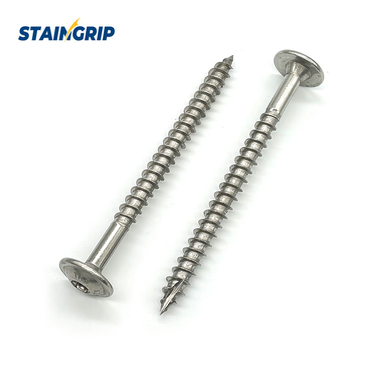
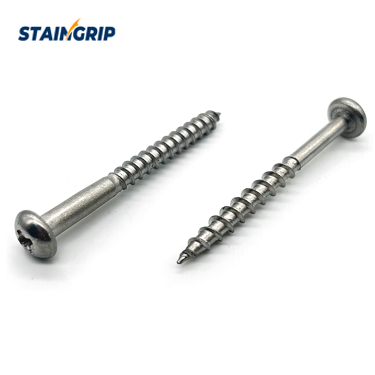
| Wafer Head Type 17 Wood Screws | 304 / 316 | #8, #10, #12 and #14 | 1–8 in (25–203 mm) | Wafer / truss flange | Torx / star drive | Type 17 | Partial thread | Passivation, head colour and specialty finishes by enquiry |
| Square Drive Pan Head Wood Screws | 304 / 316 | #8, #10, #12 and #14 | 1–8 in (25–203 mm) | Pan | Square #1 / #2 | Sharp / gimlet | Partial thread | Head colour, passivation and specialty finish by agreed specification |
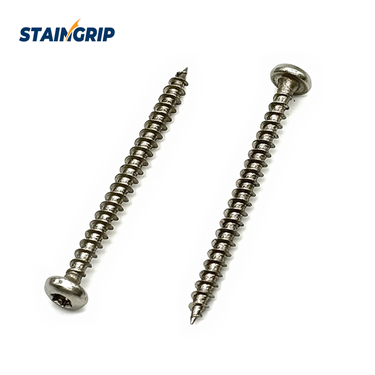
| Torx Pan Head Wood Screws | 304 / 316 | #8, #10, #12 and #14 | 1–8 in (25–203 mm) | Pan | Torx; bit to confirm | Sharp / gimlet | Full coarse; confirm drawing | Head colour, passivation and specialty finish by agreed specification |
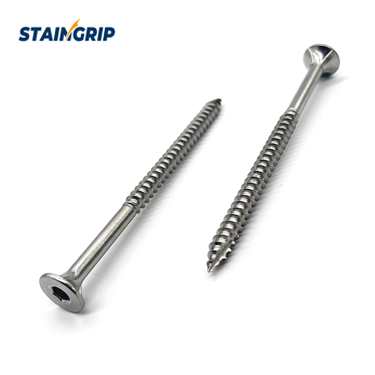
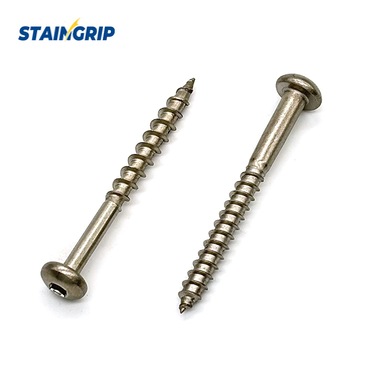
| Bugle Head Type 17 Wood Screws | 304 / 316 | #8, #10, #12 and #14 | 1–8 in (25–203 mm) | Curved bugle head | Torx / internal hex; confirm | Type 17 | Partial thread | Head colour, passivation and specialty finish by agreed specification |
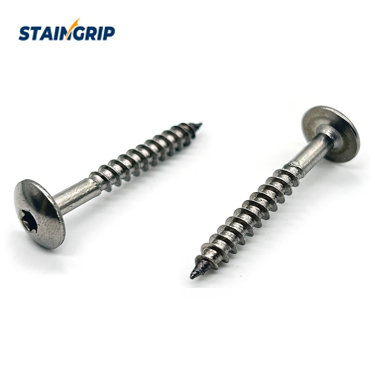
| Torx Flange Head Wood Screws | 304 / 316 | #8, #10, #12 and #14 | 1–8 in (25–203 mm) | Flange button | Torx; bit to confirm | Sharp / gimlet | Partial thread | Head colour, passivation and specialty finish by agreed specification |
| Phillips Pan Head Wood Screws | 304 / 316 | #8, #10, #12 and #14 | 1–8 in (25–203 mm) | Pan | Phillips cross recess | Sharp / gimlet | Partial; shank to specification | Head colour, passivation and specialty finish by agreed specification |
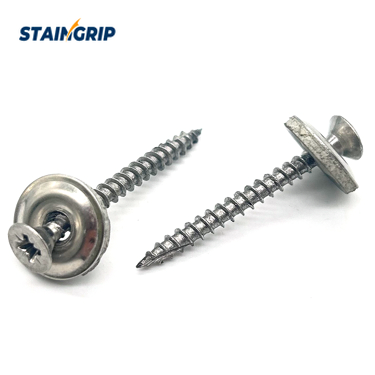
| Type 17 Chipboard Screws with Washer | 304 / 316 | #8, #10, #12 and #14 | 1–8 in (25–203 mm) | Countersunk + SS washer | Cross / Torx / Pozi; confirm | Type 17 | Coarse wood / chipboard thread | Head colour, passivation and specialty finish by agreed specification |
Scroll horizontally to compare all specification fields. Inch ranges are nominal catalogue ranges; approve final dimensions and units on the quotation.
Use the product rows above for listed model options. Wider dimensions and alternative drives can be submitted for a quotation and feasibility review.
| Parameter | Listed product scope | Custom enquiry scope |
|---|---|---|
| Diameter | Listed models: #8, #10, #12 and #14. | Extended enquiry: #6–#15 or a specified metric diameter within 3.5–8.0 mm. Submit the actual major diameter and thread drawing; gauge and metric ranges are not exact equivalents. |
| Length | Listed models: 1–8 in (approximately 25–203 mm). | Extended enquiry: ½–9 in; alternatively state the required metric length in the 12–228 mm brief. Confirm the exact dimension and head-dependent measurement method. |
| Material / construction | Current wood designs list 304 / 316. | 305 or hardened 410, including a requested ¾–9 in or an exact metric length within 20–228 mm length brief, requires a separate design and availability review. A harder alloy does not establish suitability for dense wood. |
| Drive recess | Torx, Square, Phillips and selected Pozi configurations; size and pictured drive vary by model. | Specify TX10–TX30, PZ1–PZ3, PH1–PH3 or SQ1–SQ3 as the required recess in a custom brief. Confirm one size with the selected head; these are not universal in-stock ranges. |
Extended ranges are quotation requests, not catalogue availability or interchangeable inch/metric conversions. The accepted drawing and quotation define the manufactured size, tolerances, grade and finish.
Use the relevant standard or agreed drawing for the exact screw. The references below explain scope; they are not a blanket compliance declaration for this collection.
| Reference | What it covers | How to specify it |
|---|---|---|
| DIN 7997Read scope ↗ | Dimensional and product requirements for cross-recessed countersunk wood screws, with 2–8 mm thread diameters, in applications that do not require construction approval. | Specify this only for a matching wood-screw form. A different head, drive or structural application needs its own applicable requirements and supporting evidence. |
| ASME B18.6.1Read scope ↗ | General and dimensional data for recognized inch-series wood screws with slotted or recessed heads. The published sizes are not a manufacturer’s stock list. | State the required edition, head, drive, diameter and length on the enquiry. Confirm compliance for the ordered item rather than the entire product family. |
| ISO 7049Read scope ↗ | Applies to cross-recessed pan-head tapping screws in the ST2.2–ST9.5 range. It is not a general standard covering every wood or deck head. | Use it only where the ordered tapping screw matches its scope. A self-drilling point or a different head needs the appropriate additional or alternative specification. |
| A2-70 / A4-80 and ISO 3506-1Read scope ↗Read scope ↗ | A2 and A4 identify stainless fastener grades; 70 and 80 identify mechanical property classes. ISO 3506-1 addresses specified ISO metric-thread bolts, screws and studs. | 304 does not automatically mean A2-70, nor 316 A4-80. Request material and finished-fastener evidence; do not directly assign these classes to wood-thread or self-drilling products. |
StainGrip can review OEM / ODM production against your drawing or blueprint. Define the complete screw, then agree the sample, inspection and packaging requirements.
| Specification item | What to provide | What can be agreed |
|---|---|---|
| Drawing / blueprint | Head profile and diameter, drive recess, thread pitch, point geometry, major diameter, length datum and tolerances. Add intended board or support materials. | We can review custom head shapes, drives, dimensions and tolerances against your drawing or a clearly identified standard. Feasibility and the approved drawing define production. |
| Material, finish & marking | Grade, exposure, head logo, colour sample, passivation or other finish; identify any required coating coverage. | Head marking, colour matching and specialty finish requests are reviewed for the selected screw. Agree the process and sample appearance. |
| Samples & inspection | Sample quantity, critical dimensions, required installation checks, material records and acceptance criteria. | Custom samples and initial inspection reports can be arranged. Agree what is measured or tested and the approval step before full production. |
| Private-label packaging | Pack quantities, polybag / inner box / bulk format, outer cartons, logo artwork, UPC / EAN data, part numbers and shipping marks. | Packaging and label layouts can be prepared from supplied artwork. Approve pack dimensions, counts and print files with the order. |
Explore head, drive and point details for timber and board connections.
EXPLORE OTHER FASTENING SOLUTIONS
START A CONVERSATION
Tell us the screw design, material, dimensions and finish you need.
Our technical engineers will contact you within one business day.