
TECHNICAL GUIDES
ASTM Stainless Fastener Standards: 304, 305, 316 & 410 Screws Guide
Complete guide to US ASTM, ASME & SAE standards for stainless steel screws (304, 316, 410, 305). Sourcing stainless steel screws for the US market? Learn ASTM F593, SAE J78 & ACQ codes for stainless steel self drilling screws, deck screws, wood screws. Get factory-direct quotes!
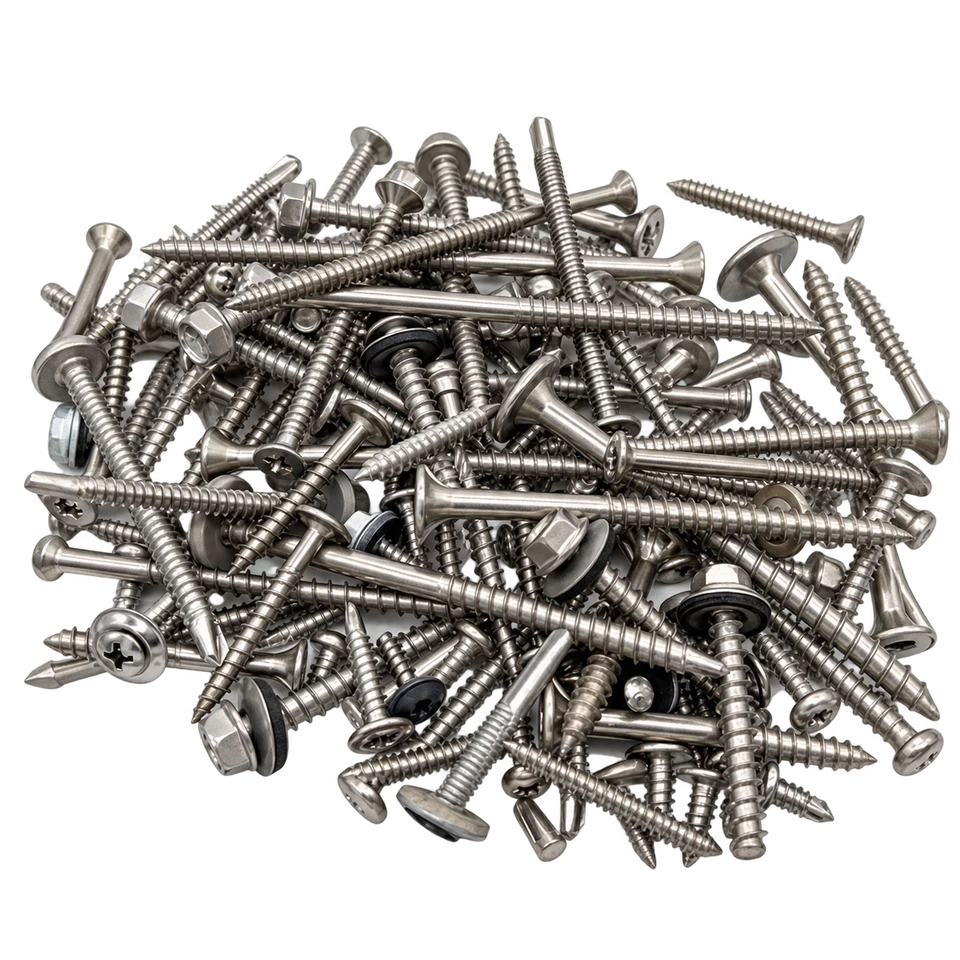
Defining US Stainless Steel Screws Standards & Building Codes
When sourcing stainless steel fasteners for the US market, compliance isn’t just a preference—it’s a structural and safety requirement. Understanding the governing standards ensures your inventory meets local building codes and client expectations.
1. ASTM Standards (Material & Mechanical Specifications)
ASTM F593: The primary standard specification for stainless steel bolts, hex cap screws, and studs. It covers chemical composition and mechanical requirements for austenitic (304, 316, 305) and martensitic (410) alloy families.
Raw-material standards: ASTM A240/A240M covers stainless steel plate, sheet and strip; ASTM A582/A582M covers free-machining stainless steel bars. For wire and wire rod used in cold heading or cold forging, ASTM A493 may be relevant. Confirm the applicable material standard and certificate for the ordered screw.
ASTM B117 (Salt Spray Testing): This practice specifies a controlled salt-spray environment. When requesting a test, identify the screw, coating, exposure period and acceptance criteria. Salt-spray results alone do not establish outdoor service life or suitability for a marine installation.
2. ASME & SAE Standards Dimensional & Drilling Performance
ASME B18.6.3: Defines standard thread pitch, head dimensions, drive recesses, and tolerances for machine, tapping, and self-drilling screw profiles in inch series.
SAE J78: Specifies key performance criteria for self-drilling tapping screws, including case hardness requirements, drill point geometry, and maximum drilling times into specified steel plate thicknesses.
3. Building Codes & Pressure-Treated Wood Compliance
Building codes and treated wood: Fastener requirements depend on the adopted code, preservative, exposure and connection. For example, 2021 IRC R317.3.1 permits specified galvanized steel, stainless steel, silicon bronze or copper fasteners, subject to its conditions and exceptions.
AC257 is an ICC-ES evaluation criterion for corrosion-resistant fasteners and the effects of wood treatments. A material grade alone does not establish compliance.
Stainless Steel Grade Comparison Matrix as per ASTM F593
How to Distinguish Stainless Steel Screw Grades According to ASTM Standards?
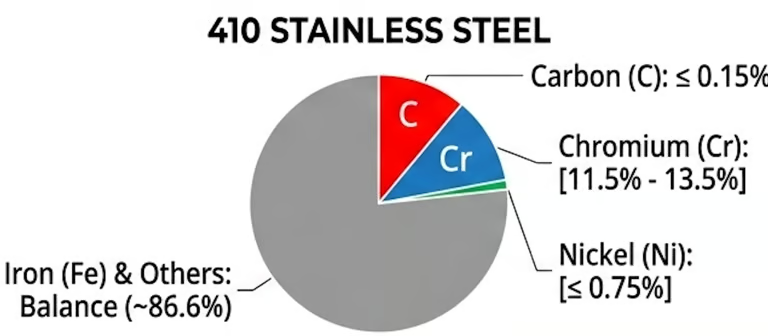
Selecting the right alloy for custom stainless steel screws requires balancing structural integrity with environmental resistance. But what key element ratios differentiate one grade from another under ASTM F593 specifications?
Below is a reference comparison table based on ASTM F593 standards. It details the primary chemical percentages—specifically Carbon, Chromium, and Nickel—for standard fastener materials like 304, 305, 316, and 410 stainless steel. Use this breakdown to quickly verify material compliance for your next sourcing project.
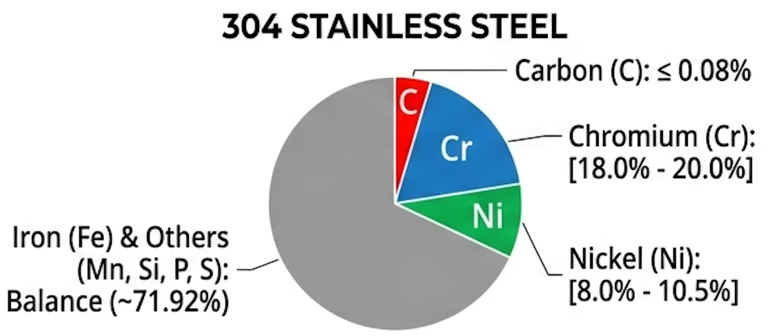
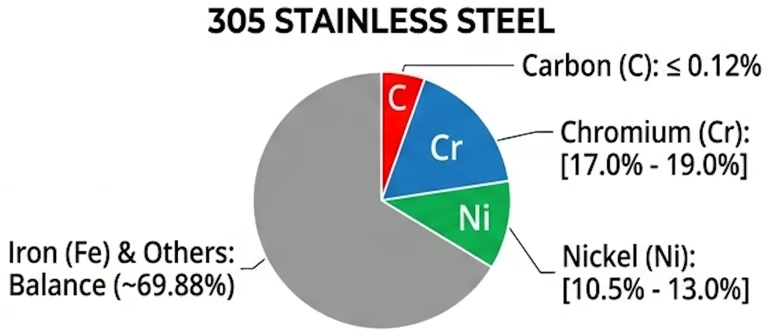
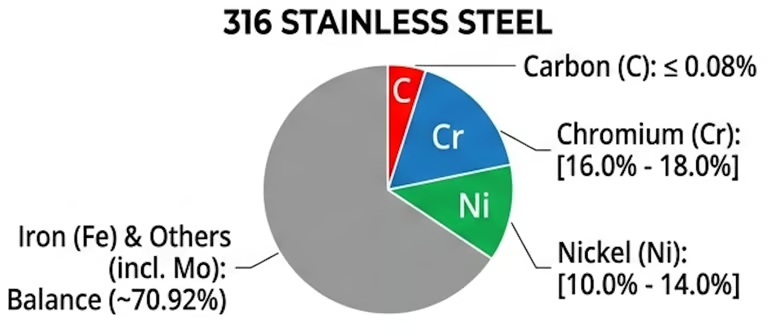
How to Select the Right Stainless Steel Screw Grade for Your Project
Choosing the optimal alloy goes beyond basic chemical composition—it directly dictates mechanical performance, installation efficiency, and long-term durability. How do you determine which stainless steel grade aligns perfectly with your environmental and structural requirements?
The comparison table below breaks down the core performance metrics across Grade 304, Grade 305, Grade 316, Grade 410, and Bi-Metal fasteners. Review their metallurgical properties, corrosion resistance levels, and tapping capabilities to select the exact grade for your application.
| Stainless Steel Grade | Metallurgical Family | Corrosion Resistance | Drilling / Tapping Capability | Best Recommended Applications |
|---|---|---|---|---|
| Grade 304 (18-8) | Austenitic | High | Pre-drilling required in hard materials | General exterior construction, decking, timber framing, siding, standard wood screws. |
| Grade 305 | Austenitic (High Nickel) | High | Pre-drilling required in hard materials | Selected decking and composite-board connections; confirm exposure and installation requirements. |
| Grade 316 | Austenitic (2% Moly) | Assess for chloride exposure; suitability depends on the environment and joint. | Pre-drilling required in hard materials | Distance from the coast alone is insufficient. |
| Grade 410 | Martensitic | Moderate | Hardenable; verify the drilling range for the selected screw and support metal. | Steel-to-steel self-drilling screws (#3, #4, #5 drill points), heavy gauge metal framing. |
| Bi-Metal (304/316 + Hard Steel) | Dual-Alloy Weld | Verify the configuration and corrosion exposure. | Verify the drilling range. | Stainless body with a hardened steel drilling section; verify the configuration, corrosion exposure and drilling range. |
Grade 304 (18-8)
- Stainless SteelGrade
- Grade 304 (18-8)
- MetallurgicalFamily
- Austenitic
- Corrosion Resistance
- High
- Drilling / Tapping Capability
- Pre-drilling required in hard materials
- Best Recommended Applications
- General exterior construction, decking, timber framing, siding, standard wood screws.
Grade 305
- Stainless SteelGrade
- Grade 305
- MetallurgicalFamily
- Austenitic(High Nickel)
- Corrosion Resistance
- High
- Drilling / Tapping Capability
- Pre-drilling required in hard materials
- Best Recommended Applications
- Selected decking and composite-board connections; confirm exposure and installation requirements.
Grade 316
- Stainless SteelGrade
- Grade 316
- MetallurgicalFamily
- Austenitic(2% Moly)
- Corrosion Resistance
- Assess for chloride exposure; suitability depends on the environment and joint.
- Drilling / Tapping Capability
- Pre-drilling required in hard materials
- Best Recommended Applications
- Distance from the coast alone is insufficient.
Grade 410
- Stainless SteelGrade
- Grade 410
- MetallurgicalFamily
- Martensitic
- Corrosion Resistance
- Moderate
- Drilling / Tapping Capability
- Hardenable; verify the drilling range for the selected screw and support metal.
- Best Recommended Applications
- Steel-to-steel self-drilling screws (#3, #4, #5 drill points), heavy gauge metal framing.
Bi-Metal(304/316 + Hard Steel)
- Stainless SteelGrade
- Bi-Metal(304/316 + Hard Steel)
- MetallurgicalFamily
- Dual-Alloy Weld
- Corrosion Resistance
- Verify the configuration and corrosion exposure.
- Drilling / Tapping Capability
- Verify the drilling range.
- Best Recommended Applications
- Stainless body with a hardened steel drilling section; verify the configuration, corrosion exposure and drilling range.
Product-Specific Application & Compliance Standards
1. Stainless Steel Self-Drilling Screws
Key Standards: SAE J78, ASME B18.6.3
The Challenge: Standard 304/316 austenitic stainless steel cannot be heat-treated to the hardness needed to penetrate thick structural steel plates.
The Staingrip Solution:
410 Stainless Steel: Precision heat-treated to drill through heavy metal sheets quickly while maintaining moderate weather resistance.
Bi-Metal Construction: Selected designs combine a 304 or 316 stainless steel body with a hardened steel drilling section. Confirm the joining method, finish, support metal and installation conditions for the selected product. Stainless steel is not immune to corrosion.
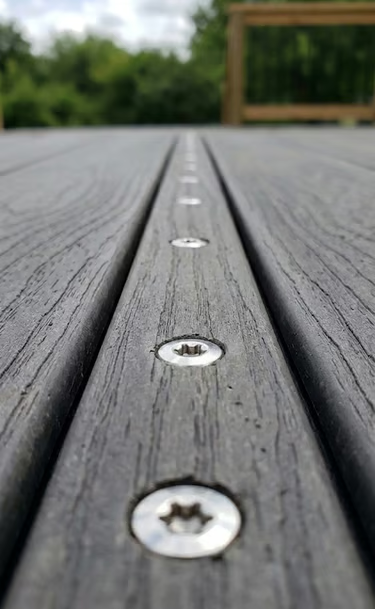
2. Stainless Steel Decking & Composite Screws
Decking: Confirm the adopted building code, product and connection requirements, and material records for the selected screw.
The Challenge: High torque demands during high-speed insertion into dense hardwoods or composite decking often cause head shear (snapping) in low-grade fasteners.
The Staingrip Solution:
Stainless grade availability depends on the selected deck screw. Match the material, board and installation requirements, and confirm the finished screw’s performance.
Deep Star/Torx drive recesses to prevent cam-out, combined with Type 17 slash points and under-head countersinking nibs for clean finish installations.
3. Stainless Steel Metal to Metal/Wood Roofing Screws
Key Standards: ASTM C1513, ASTM D2000 (EPDM Gaskets)
The Challenge: Exposure to rain, UV rays, and thermal expansion causes roof leaks if washers degrade or threads back out.
The Staingrip Solution:
Selected roofing designs combine a stainless steel screw with a bonded EPDM sealing washer. Confirm the material and sealing assembly for the ordered model.
Specify the washer material, service-temperature range, weathering requirements and installation conditions. Request the corresponding supplier or test documentation for the selected assembly.
4. Stainless Steel Wood Screws & Heavy Duty Wood Construction Screws
Wood screws: ASME B18.6.1 is a dimensional reference for applicable inch-series wood screws. Confirm material and mechanical requirements separately.
The Challenge: Massive shear loads in timber framing and log home construction require elevated pull-out and shear values.
The Staingrip Solution:
Select the coarse-thread design and embedment for the actual timber and joint.
Confirm the screw diameter, pilot-hole requirements, edge distances and the required shear and withdrawal evidence for the selected connection.
5. Stainless Steel Sheet Metal Screws & Self-Tapping Screws
Sheet-metal screws: Confirm applicable dimensional and performance standards for the selected screw and assembly.
ASTM F593 applies to bolts, hex cap screws and studs within its scope; it is not a blanket specification for these screw families.
The Challenge: Sheet-metal joints vary in material, thickness and prepared-hole dimensions. Confirm thread engagement and installation requirements for the selected self-tapping or Type F thread-cutting configuration.
The Staingrip Solution:
Material and point selection: The linked sheet-metal designs list 304 / 316 stainless steel. Select a sharp self-tapping design or a Type F thread-cutting design to suit the prepared hole and receiving material.
Type A / AB options and Type F cutting ends are different configurations. Confirm the ordered drawing, hole preparation, thread engagement and installation requirements for each model.
Frequently asked questions
Why can’t I use standard 304 stainless steel self-drilling screws into 1/4" steel plates?
Grade 304 stainless steel belongs to the austenitic family, which cannot be hardened through heat treatment. When forced into thick structural steel, the drill point will dull or burn out before penetrating. For steel penetration, specify Grade 410 Stainless Steel or Bi-Metal Screws (304/316 head with a hardened drill point).
How should fasteners be specified for ACQ pressure-treated lumber?
Identify the preservative, exposure and connection, then check the adopted code and the fastener and treatment suppliers’ requirements. Stainless steel is one option; other specified corrosion-resistant systems may also be permitted. Confirm the selected product’s documentation and conditions of use.
What is the main difference between Grade 304 and Grade 305 for decking screws?
Grade 305 has higher nickel content and reduced work hardening compared with Grade 304, which supports cold forming. This material characteristic alone does not establish a finished screw’s driving torque or resistance to head breakage.
Get a Fast Quote Today
Looking for standard or custom stainless steel screws? Contact our engineering team for factory-direct pricing, MTR reports, and fast shipping. We will get back to you within 1 business day upon receiving your inquiry.
References and scope
These sources explain general material behaviour and standard scopes. They do not certify every StainGrip product or replace the drawing, installation requirements and test records for an ordered item. Confirm the applicable standard and edition with your specification.
- ASTM A240/A240M-26 official scope
- ASTM A582/A582M-22 official scope
- ASTM A493-25 official scope
- ASTM F593-24 official scope
- ASME B18.6.1 — Wood Screws (Inch Series)
- 2021 IRC Chapter 3, R317.3.1
- ICC-ES AC257 official description
- ASTM B117 official significance and use
- Outokumpu Core 305/4303 on official product page
- BSSA — Forms of corrosion in stainless steels