
Before accepting an hours-only quotation or report, complete the salt spray acceptance outline. Leave duration and pass/fail limits open until the applicable requirement and test purpose are agreed.
What do the test standards actually establish?
ASTM B117-26a addresses salt-fog apparatus and operating conditions. ISO 9227:2022, with its 2024 amendment, covers specified salt spray methods and leaves product-specific exposure periods and interpretation to the relevant specification. These documents do not assign a single passing time to the word stainless. The purchase order or applicable product specification must supply the missing acceptance requirement. 1 2
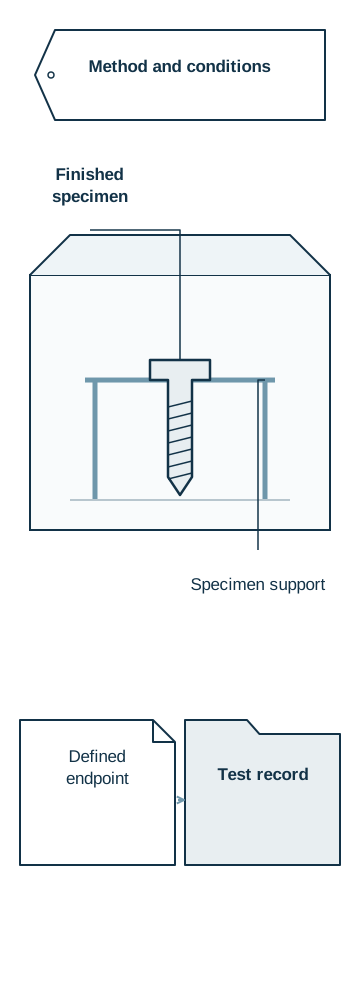
Why must the method and sample condition match?
Swipe the table sideways to compare every column. Keyboard: use the left and right arrow keys.
| Comparison variable | Why it must be recorded |
|---|---|
| Method and conditions | The standard name is only the starting point; the selected method and specimen state must also match. Neutral salt spray, acetic acid salt spray and copper-accelerated acetic acid salt spray use different conditions. Their hour counts cannot simply be ranked as if they were the same test. |
| Specimen type | Results also depend on whether the specimen is a finished screw, an assembly or a specially prepared coupon. |
| Preparation before testing | Washing, polishing or adding a temporary protective film before testing can make a sample unrepresentative of normal delivery. 2 |
Why surface-treatment names cannot supply a passing time
The final surface condition is part of the specimen definition, but its process name cannot set the acceptance time. No fixed ladder links cleaning, passivation, electropolishing or sealing to a universal salt spray duration. Grade, surface contamination, process control and final handling all matter. ASTM A967/A967M includes alternative ways to check passivation effectiveness; completing a named treatment differs from demonstrating the applicable acceptance requirement. Representative parts tested after the relevant final processing and handling provide evidence for the delivered condition. 3
If a finish option is being considered, Special Coating Solutions for Stainless Steel Screws helps identify the surface treatment to discuss. Its name alone does not establish a salt spray duration or acceptance result.
What can rust on a stainless screw mean in the chamber?
Once the sample and method are defined, the observed change needs interpretation. Its location and character are relevant evidence before a cause is assigned. A brown stain associated with deposited iron, visible attack of the stainless substrate and corrosion of a metallic coating are different findings. Photographs of the evaluated head, recess, threads and contact regions preserve their distribution. Agreed post-test handling provides a consistent basis for determining removability and whether a pit is present.
This distinction matters when comparing 304, 316 and heat-treated 410 products. The test represents a particular material and surface condition, rather than a grade name in isolation. An unexpected result therefore raises questions about traceability, preparation and handling before it can challenge normal material-selection principles. Product quality control and exposure-specific material selection remain separate uses of evidence.
Turn the observations into a written acceptance requirement
Swipe the table sideways to compare every column. Keyboard: use the left and right arrow keys.
| Field | Requirement to complete or agree |
|---|---|
| Part and revision | [Part number; drawing/specification revision; lot identity]. Identify exactly which screws the requirement covers. |
| Material and supplied surface | [Material designation; final surface treatment; supplied condition]. State whether the samples represent normal delivery. |
| Method and edition | [Test method; standard edition; selected procedure]. Do not compare different salt spray methods by hours alone. |
| Sample selection and arrangement | [Sampling quantity/basis; loose screw or assembly; arrangement; mating materials where applicable]. |
| Preparation and handling | [Cleaning or other preparation before exposure; observation and post-test handling procedure]. Identify any departure from the supplied condition. |
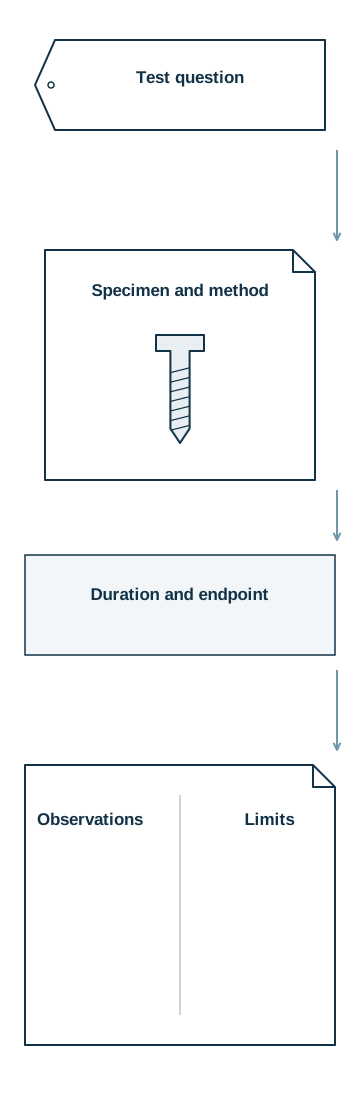
| Duration and endpoint | [Agreed exposure duration; scheduled endpoint or first-observed-failure basis]. Leave unspecified values for agreement. |
| Significant surfaces and observations | [Head; recess; threads; contact areas or other specified surfaces; observation records/photographs]. Define what is evaluated. |
| Failure criteria | [Agreed rust, pitting or coating-defect definitions and limits; relevant surfaces]. State the product-specific pass/fail requirement. |
| Report, deviations and disposition | [Lot/sample IDs; method and actual test conditions; observations/results/photos; deviations; permitted retest/rework procedure]. Retain original failed observations. |
The written criterion needs a clear endpoint: a scheduled exposure time or the first observed failure. Compliance at a scheduled endpoint shows that the specimen met that requirement; it does not establish the exact time to failure. A shared definition of observations such as a brown spot also prevents incompatible pass/fail interpretations.
The inspection discussion on Quality & Testing for Stainless Steel Screws can be based on these agreed fields, so the test request and quotation refer to the same acceptance requirement. A general quality page does not provide a passing duration for an individual product.
How should a supplier change be compared?
Swipe the table sideways to compare every column. Keyboard: use the left and right arrow keys.
| Comparison control | Required basis and limitation |
|---|---|
| Product and acceptance basis | A supplier comparison becomes meaningful only after the acceptance basis is fixed. Consistent product drawings, material requirements, final finishes, sample preparation and evaluation rules allow the comparison to address the intended difference. |
| Representative selection | Representative samples are more informative than a selection of only the brightest pieces. |
| Laboratory runs | The report also needs to identify whether the lots shared one run or used separate runs with appropriate laboratory controls. |
| Changes that confound the comparison | Simultaneous changes in surface treatment, sample condition and method make the result difficult to interpret. |
Keep the original failed observations in the disposition record and follow the agreed retest or rework procedure. Testing successive samples until one set passes does not explain the failed population. Investigate whether the problem follows a batch, handling step or screw feature, then define the corrective action and release evidence.
Can test hours be converted into years outdoors?
Even a well-controlled comparison remains evidence for its specified laboratory conditions. Test hours cannot be converted into outdoor years by a universal multiplier. ASTM notes the limitations of using salt spray alone to predict natural exposure. Real joints experience different wetting, drying, crevices, contaminants and maintenance. A laboratory result therefore serves its defined quality-control purpose, while actual exposure needs a separate assessment. A report stating passed is valuable only when its method, specimen and acceptance definition are recoverable. 1
Example: the same hours can describe different results
In a hypothetical comparison, two reports state the same exposure duration. One tests finished screws with their normal delivered surface and evaluates all specified areas. The other tests specially polished pieces and evaluates only the head. Those statements do not demonstrate equivalent conformity. Specimen preparation, significant surfaces, observations and the written acceptance requirement determine what each result actually establishes.
For a complaint involving a sheltered coastal joint, a laboratory release test is only one part of the response. Installed contact geometry, salt retention and cleaning access provide additional service evidence. The chamber can identify a difference under controlled conditions; a longer test alone cannot reproduce every interaction in the customer’s assembly.
Common questions
Should a certificate report hours to failure or the scheduled endpoint?
The certificate needs to identify which outcome was measured. If no defined failure was observed at the scheduled endpoint, the supported conclusion is compliance at that endpoint. This observation is neither an exact lifetime nor proof that later failure is impossible.
Should screws be installed before salt spray testing?
That depends on the specified purpose. Supplied loose screws represent a different condition from an installed connection with mating surfaces, contact damage and moisture-retaining interfaces. The test plan therefore needs a defined specimen state and, for an assembly, identified mating materials. Neither result automatically replaces the other. For a complaint about rust after installation, an agreed assembly test may help investigate installation effects while retained loose samples provide a separate reference.
Reference Standards
- ASTM B117-26a — Operating Salt Spray (Fog) Apparatus
- ISO 9227:2022 and Amendment 1:2024 — Salt Spray Tests
- ASTM A967/A967M-25 — Chemical Passivation Treatments for Stainless Steel Parts
These references describe standards and test methods within their stated scope. Listing a standard does not mean that a StainGrip product is certified to it or that a specific batch has passed a test.