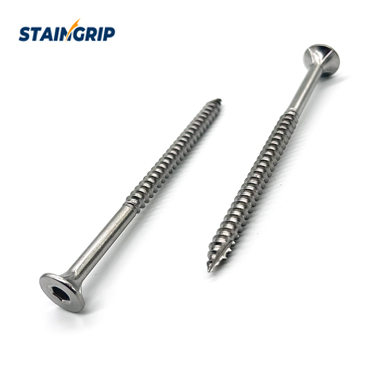
Assess each fixing location for atmospheric salt, splash or immersion, then record shelter, water traps and cleaning access. Use that exposure record before choosing a grade or test.

Why is distance from the shore not enough?
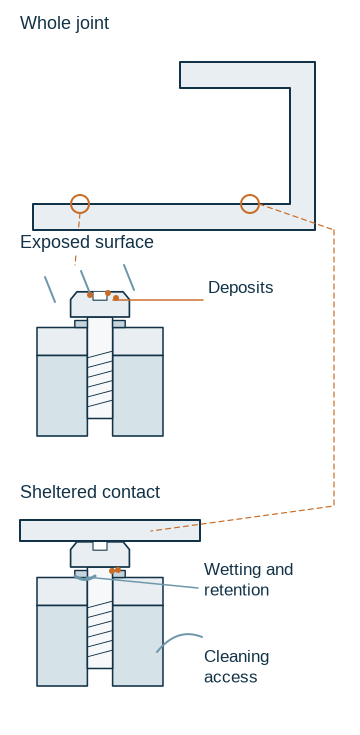
Distance from the shore is a screening input, not the complete exposure. Wind, surf, shelter and rain washing affect the actual fixing. A head beneath an overhang may retain salt without regular rain cleaning, while a washer underside or engaged thread may have a different wetting history from the visible head. Record those local conditions instead of assigning one exposure to every screw on a building.
Classify the exposure before selecting a test
A description of local exposure provides the context for grade selection and interpretation of test reports. The following distinctions keep unlike service conditions from being treated as equivalent.
Swipe the table sideways to compare every column. Keyboard: use the left and right arrow keys.
| Exposure described by the buyer | What the qualification needs to address |
|---|---|
| Coastal atmosphere with regular rain washing | Local salt burden, final surface and appearance requirements define the relevant conditions. An open location still needs representative inspection; rain exposure is not proof that every recess or underside is washed effectively. |
| Sheltered coastal fixing with limited cleaning access | Deposit retention and moisture traps at the actual screw detail are important evaluation targets. The selection needs a defined inspection and maintenance approach, or recognition that access is unavailable when material and design are chosen. |
| Direct seawater splash or immersion | This is a distinct service condition requiring its own material and joint assessment. Atmospheric staining guidance and a generic laboratory report do not establish suitability for sustained wet exposure. |
What does a change from 304 to 316 achieve?
With the exposure defined, the grade comparison has a clear purpose. Changing between these grades changes the material’s corrosion-resistance basis and is often worth evaluating where chlorides are important. However, there is no universal statement that 316 lasts two or three times as long as 304. Mass loss, pitting behavior and time to visible staining are different measures. A producer’s material datasheet supports grade assessment; it does not certify the finished screw, its surface cleanliness or its installed life.
Specify the complete stainless screw, not a marine label
Swipe the table sideways to compare every column. Keyboard: use the left and right arrow keys.
| Specification item | Requirement and limits |
|---|---|
| Traceable material and finished properties | A candidate grade must then become a complete finished-screw specification. A traceable material designation and appropriate finished mechanical requirements are essential parts of that specification. A description such as marine grade is incomplete without these details. |
| Applicable designation and class | For screws within ISO 3506-1, material designations and property classes must be interpreted in that specification; an A4 marking alone is not a complete statement of strength. |
| Self-drilling function | For a self-drilling product, point construction and drilling function are additional requirements. A corrosion-oriented alloy selection must still produce a screw that can make the required connection without damaging its drive, thread or substrate. 1 |
Contacting materials and final surface condition belong in the inquiry because an isolated stainless sample cannot describe every interface in an installed joint. Crevices, deposits, surface finish and dissimilar-metal contact are relevant factors in that corrosion assessment. A drawing that identifies sealed interfaces, drain paths and potential water traps allows these conditions to be reviewed before ordering.
For timber fixings, Stainless Steel Wood Screws connects this exposure review with the wood connection and screw selection. The guide supports specification discussions; the actual coastal location still needs its own assessment.
For a timber-fixing inquiry, Stainless Steel Bugle Head Type 17 Wood Screws lists a 316 material option. It is a relevant design to discuss when specifying grade and engagement, subject to confirmation of the exact screw and coastal exposure; the listing is not an immersion or marine-service approval.
How should tea staining and structural damage be separated?
The specification also needs to state which deterioration matters for acceptance. Tea staining is an appearance issue associated with certain atmospheric exposures, while pitting, crevice corrosion or cracking can require a different engineering response. A brown mark does not quantify lost load-bearing section. Equally, removing a stain does not prove that the underlying condition is harmless. A complete acceptance requirement states whether it concerns visible appearance, corrosion damage, retained function or several of these outcomes.
Example: separate exposed and sheltered fixings on one building
In a hypothetical project, the same stainless screw is proposed for an open exterior bracket and a second bracket beneath a deep canopy. Both locations share the same coastal address, but their washing and deposit histories differ. A site assessment could compare salt accumulation, wetting and cleaning access at each fixing, including differences between the concealed thread and visible head. That evidence would allow the selection record to explain why one specification covers both locations or why the sheltered detail needs a different material, surface treatment or design review.
An informative inspection plan records location and condition rather than only the number of rusty screws. Representative head photographs and examination of accessible interfaces can support that record. Rapid recurrence of deposits calls for review of local maintenance and design assumptions rather than an automatic grade change across the project. Corrosion in a load-bearing region raises separate questions about retained function and replacement criteria. Maintenance records need to distinguish these engineering findings from cosmetic cleaning results.
Bring the site assessment into the coastal screw inquiry
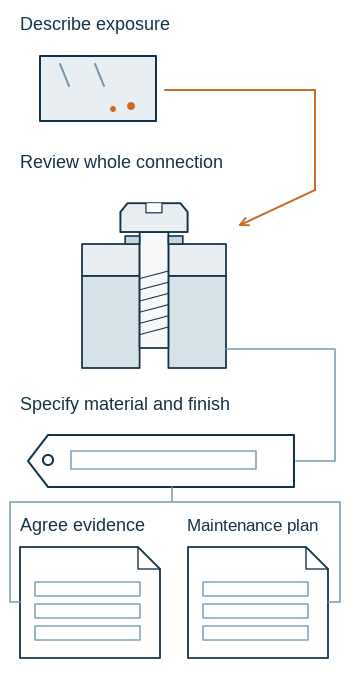
The exposed-and-sheltered comparison can become a purchasing record that connects each location to its requirements. The following information gives material selection, qualification and maintenance a shared review basis.
Swipe the table sideways to compare every column. Keyboard: use the left and right arrow keys.
| Check | Required information |
|---|---|
| Connection and function | The drawing, substrate and load or installation function. |
| Exposure category | Atmospheric salt exposure, direct splash or immersion, identified separately. |
| Shelter and water traps | Sheltered locations, drainage details and likely crevices. |
| Material and inspection | Specified material, final surface and traceable inspection evidence. |
| Maintenance and appearance | Cleaning access, planned maintenance and the acceptable appearance condition. |
Building guidance about atmospheric staining should not be used as an immersion rating. Likewise, a short salt spray report is not a promise of years near the sea. A relevant qualification therefore represents the actual exposure and finished connection.
For deck-board projects, Stainless Steel Deck Screws helps connect the site description to the board and joist configuration. Neither a deck-screw label nor a coastal address establishes the qualification of the proposed joint.
Common questions
Can a material upgrade replace cleaning and drainage?
No. More resistant material can improve the selection margin, but local salt accumulation and retained moisture still need attention in the connection design and maintenance plan.
Does a bright or electropolished screw guarantee coastal suitability?
No. Surface processing can help achieve a suitable clean finish, but appearance does not identify the alloy or qualify the installed exposure. Material, final geometry, specified treatment and service conditions all form part of the assessment. Appearance approval is one requirement within that assessment, not the entire corrosion specification.
Reference Standards
These references describe standards and test methods within their stated scope. Listing a standard does not mean that a StainGrip product is certified to it or that a specific batch has passed a test.