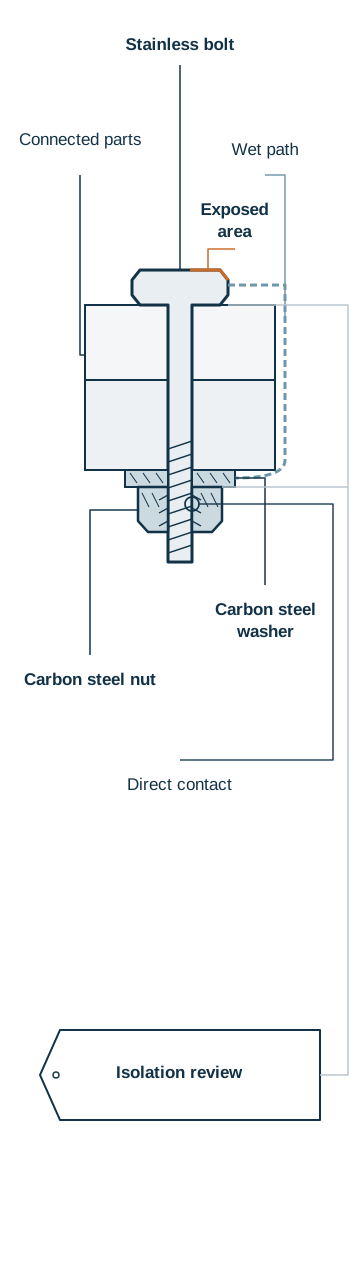
List every metal and coating in the connection. Trace where moisture remains and where electrical contact continues, including beneath washers and inside engaged threads.

Why does the actual wet environment matter?
Two dissimilar metals touching in a dry location do not automatically create damaging galvanic corrosion. Water, salt solutions or other conductive moisture can complete the corrosion circuit. A sheltered joint may still retain condensation, and a washer contact can remain wet after the surrounding surface dries. The interface condition, including coating damage and trapped deposits, therefore explains the exposure more accurately than an indoor or outdoor label alone.
What is important about the area ratio?
When moisture completes the circuit, the wetted area relationship helps explain where damage may concentrate. A relatively small area of active metal coupled to a larger wetted area of a more noble metal can concentrate corrosion on the active part. The relevant areas are the exposed, electrically connected and wetted surfaces, not merely the total catalog dimensions. A small carbon steel component in a large stainless assembly can therefore deserve particular attention, but geometry alone cannot provide a universal corrosion rate.
What changes when a stainless screw enters coated carbon steel?
A stainless screw in coated carbon steel applies these circuit and area relationships to a common contact geometry. The exposed head is only part of the connection. Coating condition at the hole, thread contact and cut edge, together with the moisture path to those regions, defines the local assessment. A zinc coating can provide sacrificial protection, but does not make exposure irrelevant. Once the coating is consumed or damaged, the underlying carbon steel and resulting contact condition become part of the corrosion system.
Swipe the table sideways to compare every column. Keyboard: use the left and right arrow keys.
| Protection question | Limitation to preserve |
|---|---|
| Passive film and bearing paint | The stainless passive film is not an electrical insulator. Ordinary paint at a highly loaded bearing contact also lacks an automatic guarantee of durable electrical isolation. |
| Protection strategy | A design may rely on moisture exclusion, a coating system, true electrical isolation or a combination, but these are distinct protection strategies. |
| Condition after installation and movement | Their details need to remain effective after the screw has been driven and the assembly has moved in service. |
The connection selection discussed in Stainless Steel Self Drilling Screw is relevant when the screw enters a metal support. Its substrate, contact and coating details must still be reviewed as part of the mixed-metal assembly.
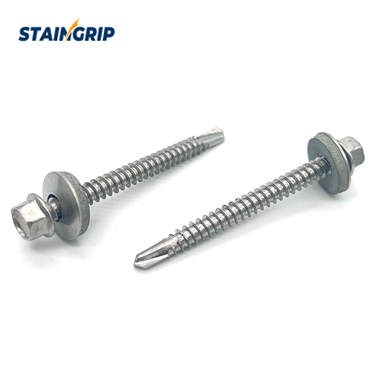
For this construction discussion, Stainless Steel Bi-Metal Hex Head Self-Drilling Screws lists a 304 or 316 stainless body with a hardened alloy carbon-steel drill tip. That makes the body, drilling section, mating metal and moisture path explicit review items. It does not show that replacing the screw alone protects a carbon-steel washer, panel or supporting thread.
Locate the corroding component before choosing a remedy
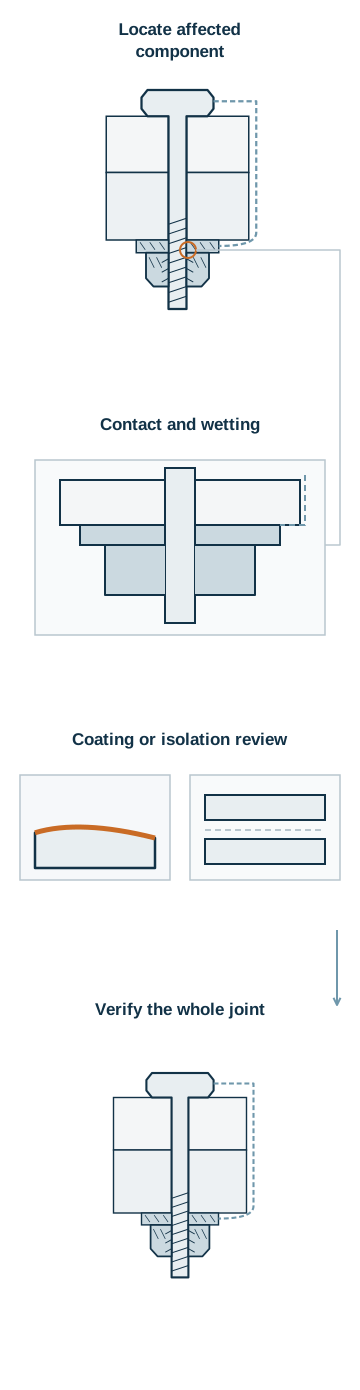
Several metals and coatings may share the contact, so a stain’s source matters before material failure is assigned. Corrosion products from a carbon steel panel, nut or washer can spread onto an adjacent stainless head. The visible stain may therefore lie on a different component from the metal being lost. Accessible underside, hole-edge and mating-thread observations help locate that source and establish whether the stainless surface itself has pits or other defects.
In a threaded connection, section loss in the less resistant mating component can matter even when the stainless screw remains intact. The condition of the component carrying thread engagement or bearing load is therefore relevant to the whole joint. The screw’s appearance cannot establish that condition by itself. Maintenance decisions depend on both remaining connection function and cosmetic condition.
Check whether the proposed isolation breaks every path
Swipe the table sideways to compare every column. Keyboard: use the left and right arrow keys.
| Isolation check | What must be considered |
|---|---|
| Remaining conductive paths | An isolation proposal needs to address the complete electrical path, not only the visible washer contact. Conductivity may remain through the bolt shank touching the hole, engaged threads or another connected component. |
| Isolation components | The combination of sleeves, washers and bearing surfaces determines whether those paths are interrupted. |
| Mechanical and service suitability | Insulating material must also accommodate bearing pressure, temperature and long-term dimensional stability. A corrosion measure that allows excessive compression or movement can compromise the original connection function. |
The options on Special Coating Solutions for Stainless Steel Screws can be considered when discussing the specified surface system. A coating listing does not demonstrate durable electrical isolation or protection of the complete joint.
What should purchasing and maintenance record?
Swipe the table sideways to compare every column. Keyboard: use the left and right arrow keys.
| Check | Required information |
|---|---|
| Metals and coatings | The connection bill of materials identifies the relevant metals and their coatings. |
| Exposure acceptance basis | The exposure assessment explains the basis for accepting the mixed-metal combination. |
| Installation protection details | Isolation, drainage and coating details define the conditions that installation must preserve. |
| Remaining load-bearing section | The active component’s corrosion and remaining load-bearing section inform maintenance decisions. |
| Stock substitution review | A proposed stock substitution of a nut or washer needs review against the accepted combination. |
Carry these records into purchasing, installation and maintenance so the complete assembly retains one agreed specification. Replacing only the stained component can leave the same local wetting and electrical paths active.
Example: a stainless replacement leaves the same rust trail
In a hypothetical wet exterior bracket, a corroded screw is replaced by stainless steel while the original carbon steel washer and bracket remain. A later brown trail below the head does not by itself show that the new screw is defective. The retained materials, washer and hole contact, and water entry and drainage paths provide the evidence needed to explain the trail. The replacement changed one component, not the complete corrosion system.
Once the source and moisture path are identified, a corrective proposal may address retained parts as well as the replacement screw through a change of mating material, coating continuity, drainage or isolation. Its suitability depends on the load path and assembly procedure. An accessible inspection location or another defined verification method also provides a way to assess the important interface. A sound-looking head is insufficient if a hidden supporting component continues to lose section.
Common questions
Are brown spots on stainless always galvanic corrosion?
No. Carbon steel dust or tool contamination can rust on stainless even without a mixed-metal structural joint. Deposited-iron contamination and corrosion driven by an assembled galvanic couple are different mechanisms and require separate investigation.
Does an all-stainless joint remove every corrosion concern?
No. Material suitability, crevices, deposits and surface contamination remain relevant. Using consistent materials simplifies one issue but does not replace exposure assessment.
Does upgrading the stainless screw from 304 to 316 protect the carbon steel?
The grade change does not remove the electrical connection or moisture path. The less resistant mating part can remain the component needing protection. The full material pair, exposed areas and coating condition determine whether the substitution addresses the problem. If the original failure involved loss of the carbon steel thread or washer, the revised design needs evidence that it protects that location and preserves mechanical function. A better stainless grade for one component is not a complete mixed-joint solution.