
Start with the job the coating must do. Complete the coating trial request before comparing finishes, and keep the approved unplated and plated conditions identifiable.
Define what the plated surface must achieve
Swipe the table sideways to compare every column. Keyboard: use the left and right arrow keys.
| Use or objective | What needs evaluation |
|---|---|
| Distinct coating objectives | A plating decision needs a measurable objective. Color matching, electrical contact behavior, assembly friction and corrosion appearance are different objectives, and a coating selected for one may need separate evaluation for the others. |
| Visible architectural screw | For a visible architectural screw, color and handling marks may dominate the appearance review. |
| Repeatedly assembled machine screw | For a repeatedly assembled machine screw, the relevant question may be whether the specified surface supports consistent assembly with its mating thread. |
The base stainless grade remains part of the specification. Plating 410 does not turn its substrate into 316, and plating 304 does not remove the need to assess the underlying material after coating damage. The specified functional surfaces and criteria for permitted contact marks explain where the deposit must perform. Approval consequently concerns the coating system and base metal together.
Use Special Coating Solutions for Stainless Steel Screws to discuss the desired surface objective against the site’s published passivation, e-coating, polymer and Ruspert options. The page does not establish that nickel or zinc electroplating is available for the proposed screw.
Why does preparation matter on stainless steel?
Once the coating objective is clear, the process must create a sound interface with the stainless substrate. The passive surface that contributes to stainless corrosion resistance can make reliable deposit adhesion more difficult. Cleaning and activation prepare an interface suitable for the chosen plating process. ASTM B254 addresses preparation and electroplating on stainless steel. The relevant outcome is an adherent, functional final coating; judging activation alone as necessarily harmful overlooks the purpose of the complete process. 1
Are all metallic coatings equivalent?
Swipe the table sideways to compare every column. Keyboard: use the left and right arrow keys.
| System question | Interpretation and limit |
|---|---|
| Layer-system variables | Reliable preparation is only part of the system: the deposited layers also determine behavior. Coating metal, thickness, layer sequence, porosity and finishing treatments influence behavior. |
| Corrosion mechanism | Zinc and nickel systems should not be explained using one oversimplified corrosion model. Galvanic action also requires an electrical path and an electrolyte, and its direction depends on the actual metal states. |
| Meaning of a coating pore | A pore in a coating is a relevant defect, but it does not by itself prove that the stainless substrate must corrode faster. |
How can plating affect screw fit and installation?
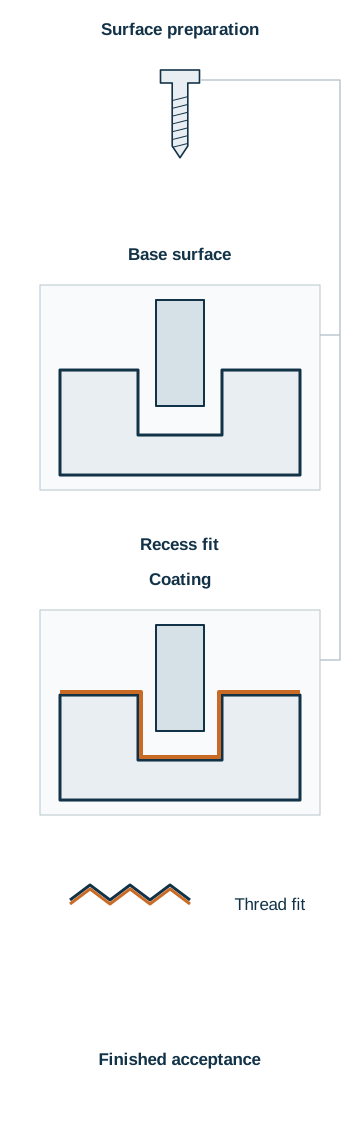
The coating system must also work with the screw geometry. A deposited layer occupies space on thread flanks, bearing surfaces and drive features, and its distribution on a real screw may differ from that on a flat test panel. Post-plating dimensional checks and compatibility with the intended mating part therefore concern the finished product. Where friction control or reduced galling is the objective, actual assembly tests provide relevant evidence because a coating change can alter the relationship between applied torque and achieved clamping.
Set acceptance requirements before the coating trial
Swipe the table sideways to compare every column. Keyboard: use the left and right arrow keys.
| Field | Record or requirement to agree |
|---|---|
| Screw and coating system | [Drawing/revision; base material; coating sequence and any topcoat]. Identify the complete system being evaluated. |
| Coating acceptance | [Appearance; adhesion; thickness; other required function; evaluation locations]. State the applicable criteria before the trial. |
| Finished fit | [Representative screw samples; dimensions to check; mating thread; driver/drive-fit requirement]. Evaluate the coated screw. |
| Corrosion comparison | [Agreed method; sample condition; failure criterion]. Keep the tested condition identifiable. |
| Assembly trial | [Mating materials; installation procedure; required result]. Relate the trial to the coating objective. |
These acceptance requirements provide the basis for comparing the trial with the original product. An unplated reference and an approved plated sample preserve the two comparison conditions. Changes to activation, coating chemistry or the base material may require renewed validation even if the finished color looks the same.
The custom-product brief on OEM Stainless Steel Screws & Packaging can identify the base screw, desired finish, finished fit and acceptance requirements. Availability of a particular metallic plating system still needs confirmation; the OEM route is not a performance approval.
How should a coating trial represent production screws?
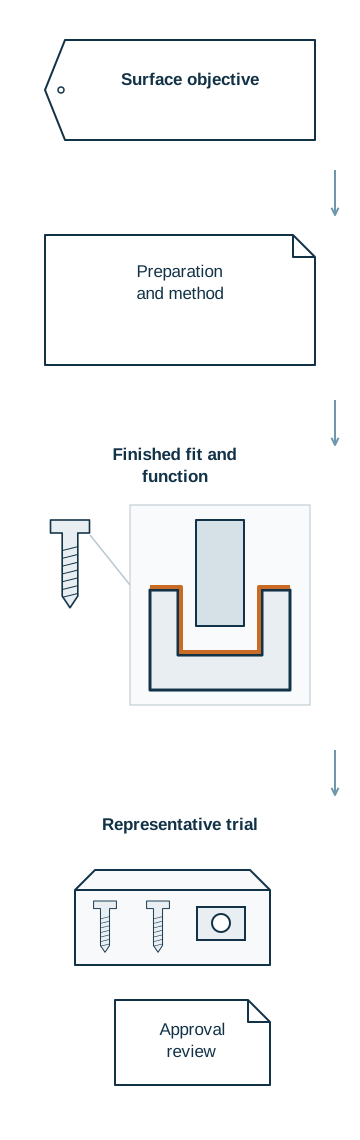
A representative trial uses the actual screw geometry and final processing sequence. Its agreed plan identifies the thickness or adhesion evaluation locations, the lot-sampling basis and the areas significant for appearance or function. Access differs between a recess bottom, thread root and exposed head. A report containing one convenient reading therefore cannot represent a complete coating map of the screw.
For an assembly-oriented coating, a comparison using the intended driver, mating material and installation procedure relates the approved and proposed surfaces to the same task. Seating results and visible deposit damage describe different aspects of performance. A change in assembly behavior calls for an explanation involving friction and fit; visually identical color does not establish interchangeability. Retained trial samples then provide a reference for later process changes.
Example: an appearance coating changes drive fit
In a hypothetical example, a stainless screw previously fits its approved bit and mating thread. A decorative plating change produces the desired color, but the bit no longer seats fully on some pieces. Final recess geometry, coating distribution and retained processing residue are relevant to explaining this change before a different driver is considered. The problem concerns the finished combination, even if the unplated screw and a flat coating panel each passed their own checks.
A corrective trial can demonstrate restored appearance and installation performance only by addressing recess engagement, thread assembly, coating integrity and the original appearance requirement on the same representative parts. Records of changed drawing allowances or process controls make the correction reproducible. This combined basis prevents a cosmetic improvement from being accepted while the screw cannot perform its basic installation function.
Common questions
Is passivation the same as electroplating?
No. Stainless passivation and metal deposition have different purposes and process definitions. A conversion treatment on zinc is also different from passivating the stainless substrate. Identifying the surface being treated is therefore essential to interpreting the process description. 2
Does a successful flat-panel test approve the screw?
It supports the process review but does not establish finished thread fit, recess coverage or actual assembly performance. Representative finished parts provide the additional evidence needed in the approval plan.
Must a new color always require a new mechanical specification?
Not necessarily. Check whether the changed layer sequence, thickness, topcoat or final cleaning still meets the existing requirements. Identify the affected fit or assembly checks and the evidence for retaining the other requirements; color alone does not establish interchangeability.
Reference Standards
- ASTM B254-26 — Preparation of and Electroplating on Stainless Steel
- ASTM A967/A967M-25 — Chemical Passivation Treatments for Stainless Steel Parts
These references describe standards and test methods within their stated scope. Listing a standard does not mean that a StainGrip product is certified to it or that a specific batch has passed a test.