
Write down the exposure, required joint load and screw type separately. Use those three inputs to check material group, property class and product-scope applicability.
Separate material, strength and assembly decisions
Swipe the table sideways to compare every column. Keyboard: use the left and right arrow keys.
| Part of the designation | A2-70 | A4-80 |
|---|---|---|
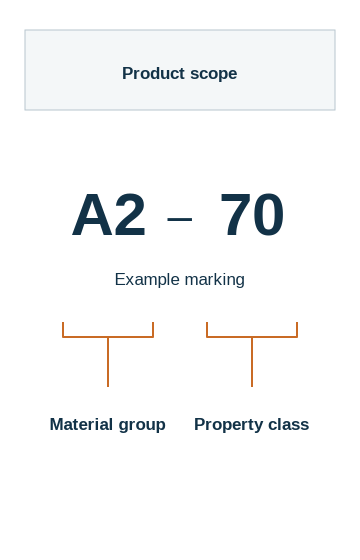
| Material group | A2: austenitic stainless, commonly associated with 304-type materials. It does not identify one exact alloy. | A4: austenitic stainless, commonly associated with 316-type materials. It does not by itself specify 316L. |
| Property class | 70: minimum tensile strength of 700 MPa for applicable fully loadable fasteners. | 80: minimum tensile strength of 800 MPa for applicable fully loadable fasteners. |
These strength values are not design allowables, universal tightening instructions or corrosion-life ratings. Choose the material for the actual exposure and assess the complete joint separately.
Swipe the table sideways to compare every column. Keyboard: use the left and right arrow keys.
| Selection question | Information needed |
|---|---|
| Which material suits the exposure? | Chlorides, chemicals, moisture retention, crevices, temperature and cleaning. |
| Which mechanical class suits the joint? | Load cases, required clamping, geometry and applicable design requirements. |
| Will the combination assemble correctly? | Mating parts, friction condition, installation method and functional verification. |
A change prompted by more demanding chloride exposure is primarily a material-suitability question. A change prompted by insufficient mechanical capacity starts from the load requirement. Either assessment may affect the final specification, but a recorded reason for each change keeps these decisions distinct.
Interpret the material group before choosing it
Each material group can include more than one exact grade. A drawing that requires 316L or another specific alloy retains that chemistry requirement, with corresponding material evidence. A group designation is not an unannounced substitute for an exact composition requirement.
Which exposure details change the stainless material choice?
Selection between those groups depends on exposure at the screw itself, rather than the project address alone. A rain-washed head and a sheltered thread interface on the same installation may experience different salt retention and drying. Cleaning products, process splash, trapped moisture and contact with other metals add relevant detail. These conditions help establish whether the proposed material group addresses the actual corrosion mechanism; labels such as outdoor or marine are too broad to provide that explanation alone.
A4 is often considered where its alloying approach is useful in more demanding chloride exposure, but it is not a universal seawater approval. A poorly drained contact can remain difficult even after a material upgrade. Material selection therefore works together with an accurate exposure description and suitable connection detail. A more expensive designation alone may leave the original cause unchanged.
Match the property class to the mechanical requirement
Mechanical class is a separate question from the environmental requirement. Product loadability, mating components and joint requirements determine how the specified strength can be used; the class number alone is not an application approval.
What if the joint uses a tapping or self-drilling screw?
Swipe the table sideways to compare every column. Keyboard: use the left and right arrow keys.
| Product-function question | Requirement and scope |
|---|---|
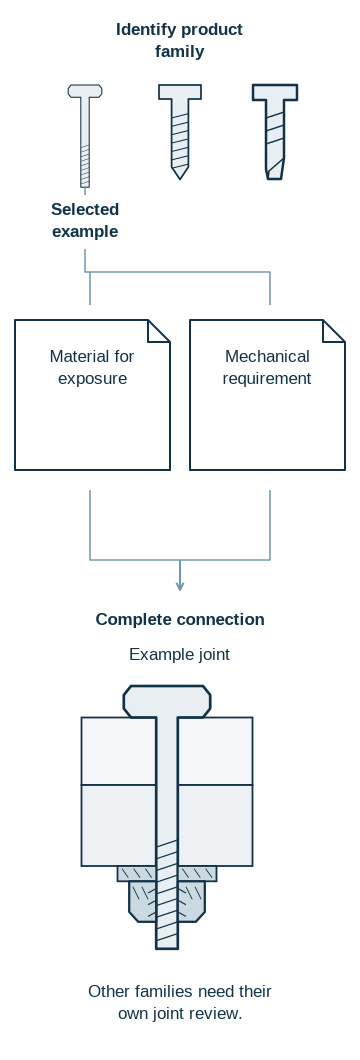
| Applicability of the class comparison | The relevance of that class comparison depends on the screw type. Tapping and self-drilling screws have product-specific requirements that are not fully described by an A2-70 versus A4-80 comparison. |
| Tapping and drilling functions | A tapping screw forms its mating thread, and a self-drilling screw adds a penetration task before engagement. |
| Representative specification | Finished properties and test arrangements need to represent these functions. Substrate material, thickness and installation method are consequently part of the specification, rather than optional background. |
A proposed heat-treated 410 screw and an austenitic stainless screw may differ in both manufacturing route and functional capability. A comparison of the actual products under the required conditions provides the basis for accepting a substitution. A successful machine-screw tensile test cannot replace drilling, driving or connection tests required by another product. The inquiry therefore needs to keep material suitability connected to product function.
Can A4-80 simply replace an existing A2-70 part?
Swipe the table sideways to compare every column. Keyboard: use the left and right arrow keys.
| Review item | Why it remains necessary |
|---|---|
| Fit and component conformity | Clear material and product requirements still leave the complete joint to be assessed for substitution. Dimensional and tolerance conformity, compatible mating parts, surface condition and assembly behavior are all relevant. |
| Friction and clamping | A friction change can alter clamping at the same torque. |
| Quotation comparability | Quotations become comparable only when those requirements align; an apparent material upgrade otherwise leaves fit, documentation or installation questions unresolved. |
When reviewing a proposed substitution, use Quality & Testing for Stainless Steel Screws to discuss the finished-product evidence and joint acceptance brief. This does not establish an A2-70 or A4-80 class for a catalog wood or drilling screw.
What else must be specified when ordering?
Swipe the table sideways to compare every column. Keyboard: use the left and right arrow keys.
| Review item | What to establish |
|---|---|
| Product and dimensions | Record the product standard or drawing, diameter and pitch, and head and shank form. |
| Material and finished condition | Specify the material, property class, final finish and inspection documents. |
| Additional functional requirements | Define any magnetic, fatigue or torque/clamp-force requirements separately; ISO 3506-1 does not provide all of these functional properties. |
| Product scope | Machine-threaded fastener classes do not automatically transfer to wood, tapping or self-drilling screws, which need their own applicable requirements. 1 2 |
The ASTM Stainless Fastener Standards: 304, 305, 316 & 410 Screws Guide provides broader context for selecting the product-family standard. Keep the exact material, property class and functional requirements in this order specification rather than transferring a class from a different screw type.
Example: corrosion improves but the order is still incomplete
In a hypothetical purchase, a buyer changes an A2 machine-screw requirement to A4 after reviewing chloride exposure. An order stating only A4 omits the mechanical class. Retain the required class and geometry, review the final finish and assembly conditions, and record separate reasons for material and strength changes.
Compare supplier responses against that complete requirement. Resolve differences in the stated material group, required documents and finish before comparing prices or approving a trial. A familiar designation is not a complete specification.
Common questions
Does specifying A4 automatically specify property class 80?
No. A4 identifies the material group; A4-70 and A4-80 describe different finished mechanical requirements within the applicable system. Use the purchase-specification checklist to state the required group and class, and assess any proposed change using the joint substitution checks. Neither an unchanged material group nor a higher class number automatically authorizes substitution. 1
Does a stronger class allow the same screw to be tightened harder?
An assembly change needs a joint assessment. The screw is only one element: mating threads, bearing surfaces, clamped material and friction can govern the usable installation condition. A stronger screw does not increase every other component’s capacity. The required clamping and selected combination determine the relevant assembly procedure. If surface condition changes with the class, its effect also needs evaluation; scaling the previous torque by strength numbers alone does not account for that difference.
Reference Standards
- ISO 3506-1:2020 — Mechanical properties of stainless steel bolts, screws and studs
- ISO 3506-4:2025 — Tapping screws with specified grades and hardness classes
These references describe standards and test methods within their stated scope. Listing a standard does not mean that a StainGrip product is certified to it or that a specific batch has passed a test.