Record why the existing 304 screw was specified and why a change is proposed. Compare the finished 410 candidate against those same requirements, with the approval range stated explicitly.
Start with the requirements the replacement must preserve
The original selection reason and the requirements the replacement must meet define the basis for comparing grades.
Swipe the table sideways to compare every column. Keyboard: use the left and right arrow keys.
| Requirement area | What the comparison must cover |
|---|---|
| Load and joint function | The applied loads, required clamping and consequences of failure. |
| Service exposure | Chlorides, chemicals, moisture retention, cleaning and temperature. |
| Fit and installation | Thread engagement, head seating and driver requirements. |
| Later processing | Any welding or other later process that can alter material properties. |
| Acceptance and access | The required appearance, inspection evidence and maintenance access. |
An exposure that justified the original choice of 304 remains part of the replacement assessment. A controlled dry indoor assembly and a salt-exposed exterior joint need different evidence. The label stainless cannot make those environments equivalent.

410 vs 304: what actually changes?
The main difference is the metallurgical and strengthening route. It changes what must be specified and verified, even when two screws have identical dimensions.
Swipe the table sideways to compare every column. Keyboard: use the left and right arrow keys.
| Question | 410 stainless steel | 304 stainless steel |
|---|---|---|
| Stainless family | Martensitic. | Austenitic. |
| Strengthening route | Can be hardened by heat treatment. State whether the finished screw is annealed or hardened and tempered, and identify its verified finished mechanical requirements. | Common strengthening routes include cold working. Document the reference screw’s finished condition and mechanical requirements. |
| What the grade name leaves unresolved | Heat-treatment condition, required whole-screw performance, final surface and suitability for the exposure. | Finished strength, required whole-screw performance, final surface and suitability for the exposure. |
| What approves substitution | Evidence that the specified finished 410 screw meets the original joint requirements. | A documented reference specification against which the proposed replacement can be assessed. |
Compare these finished specifications, not alloy names alone.
Compare finished conditions rather than alloy names alone
Check processing and final-surface records against the conditions in the comparison table. A material certificate alone does not establish heat-treatment history or final cleanliness; otherwise a nominal alloy comparison may conceal different strength levels and surface systems.
Why is greater hardness not enough?
The recorded condition may explain a hardness difference, but the application still determines which properties need acceptance. Hardness does not describe every failure mode.
Swipe the table sideways to compare every column. Keyboard: use the left and right arrow keys.
| Performance question | Meaning of the hardness evidence |
|---|---|
| Wear or penetration | Hardness can help meet a particular wear or penetration requirement; it is not a complete description of the joint’s performance. |
| Other joint demands | A joint may also depend on ductility, resistance to bending, torsional performance or retained section after corrosion. These remain part of the acceptance requirement. |
| Self-drilling function | Drilling into the intended material stack is a product-level function. A single hardness measurement cannot establish that function. |
| Tensile property class | A single hardness measurement cannot establish a tensile property class. |
A higher hardness target also needs an appropriate balance with toughness and the intended installation loading. A maximum-hardness target lacks a sound basis when the relevant failure mode has not been identified. A point that resists wear may be useful, while a head or shank that cannot tolerate the actual bending or torsional demand is not. The correct acceptance package connects material condition to the relevant whole-screw tests.
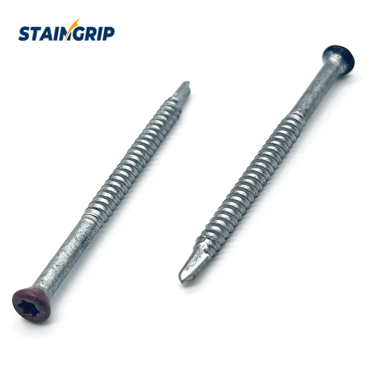
One product-specific example is StainGrip’s heat-treated 410 trim-head screws for boards fixed to metal joists. Their listed use connects the material to a defined drilling and fastening task. Board preparation, joist material and thickness, thread engagement and the protective finish still need to match the ordered configuration.
Compare samples against the same application criteria
A pre-test comparison plan connects the performance requirements to the sample evaluation. The controls below keep the comparison tied to the original application.
Swipe the table sideways to compare every column. Keyboard: use the left and right arrow keys.
| Comparison item | What to keep clear |
|---|---|
| Dimensions | Match the sample dimensions so intended differences remain identifiable. |
| Installation procedure and test conditions | Use matched installation procedures and test conditions so intended differences remain identifiable. |
| Additional coating on the 410 candidate | If the 410 candidate has an additional coating and the 304 reference does not, the comparison evaluates those complete systems. It cannot establish equal corrosion resistance of the base materials. |
| Failure criteria | Agree the failure criteria before testing so the result remains relevant to the original requirement. |
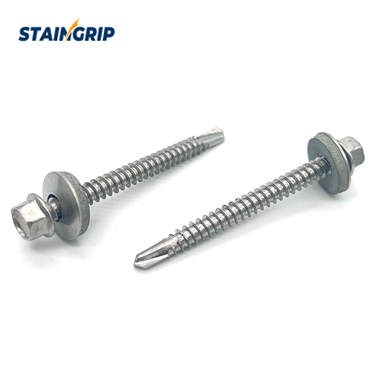
Construction can differ as well as grade. The 304/316-body bi-metal hex-head range uses a hardened alloy carbon-steel drill tip for sheet-to-steel connections. That is a different complete product to evaluate against a fixing detail, not evidence that a solid 410 screw can replace any 304 screw.
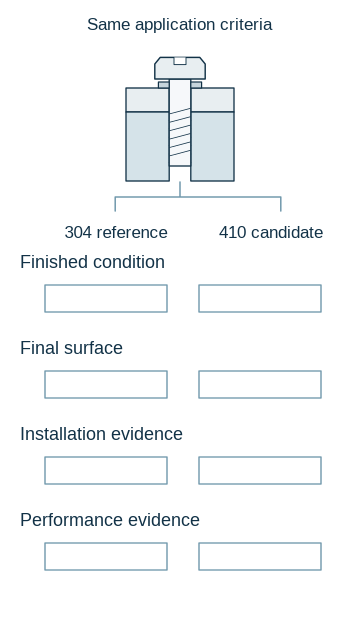
Example: approve an indoor assembly without extending the claim outdoors
In a hypothetical dry indoor enclosure, a 410 candidate is evaluated to replace a 304 screw for a particular penetration requirement. Use the actual substrate, point, thread and tool program, with agreed mechanical and appearance criteria. Approval covers that documented controlled environment. Moving the part to a salt-exposed outdoor cover requires a new corrosion and joint-design assessment; the indoor installation trial does not answer that service question.
For a coated 410 option, record the coating system and its condition after installation at the point, thread contact and driver recess. An intact laboratory specimen may expose different regions from an installed screw. Assess the delivered and assembled condition: any demonstrated improvement applies to that complete system, not to metallurgical equivalence between 410 and 304.
Record the approval scope and repeat-order specification
A cost comparison needs the same basis on both sides. A lower material purchase price does not guarantee a lower cost for a compliant connection. The substitution record must also make the approved solution repeatable.
Swipe the table sideways to compare every column. Keyboard: use the left and right arrow keys.
| Record item | What to include |
|---|---|
| Comparable cost scope | The finished part, heat treatment, surface treatment, inspection, installation and any relevant maintenance implications. |
| Existing requirement and reason for change | The existing drawing revision and the reason for the proposed substitution. |
| Candidate specifications | Two complete candidate specifications. |
| Qualification scope | The intended qualification range, with unchanged requirements distinguished from those requiring new evidence. |
| Evidence traceability | The connection between samples, treatment batch and test report. |
| Approval and authorization | A record of the approved specification and substitution authorization so later orders can repeat the evaluated solution. |
| Repeat-order description | After approval, an updated purchase description rather than an informal instruction to use the other stainless grade. |
This connects a technically acceptable sample to repeatable supply of the approved finished screw.
Common questions
Can a successful trial approve every screw size?
No. Geometry, forming, heat-treatment response and installation loads can change with size. The approved trial represents a defined range; changes outside that range need a separate review.
Is magnetic attraction a useful substitution certificate?
No. It may help an assembly process, but it does not verify alloy identity, finished strength or suitability for the intended exposure.
Does a passivated 410 screw become a 304 equivalent?
No. Surface treatment can address an appropriate surface requirement, but it does not replace the alloy composition or its hardening route. The relevant comparison concerns the treated screw’s actual corrosion and mechanical criteria, with material identity and processing documented separately.