
Identify the stainless family and actual heat history before approving rework. Keep corrosion, mechanical and dimensional checks separate in the review record.
Identify the stainless family before judging the heat cycle
Swipe the table sideways to compare every column. Keyboard: use the left and right arrow keys.
| Material family | Processing purpose |
|---|---|
| Martensitic 410 | 410 is a martensitic stainless steel that can be hardened by an appropriate quenching and tempering route. Quenching develops the hardened structure; tempering adjusts the final balance of hardness, strength and toughness. |
| Austenitic 304 and 316 | Austenitic 304 and 316 are not hardened by conventional quenching: cold working is their usual strengthening route. Solution annealing and rapid cooling of these austenitic grades serve a different purpose from hardening 410. |
Heat treatment does not make 410 automatically equivalent to 304 or 316 in corrosion resistance. The thermal cycle, final surface condition and exposure environment still matter. The manufacturing sequence and finished-part checks are discussed in Why Are 410 Stainless Steel Screws Heat Treated?
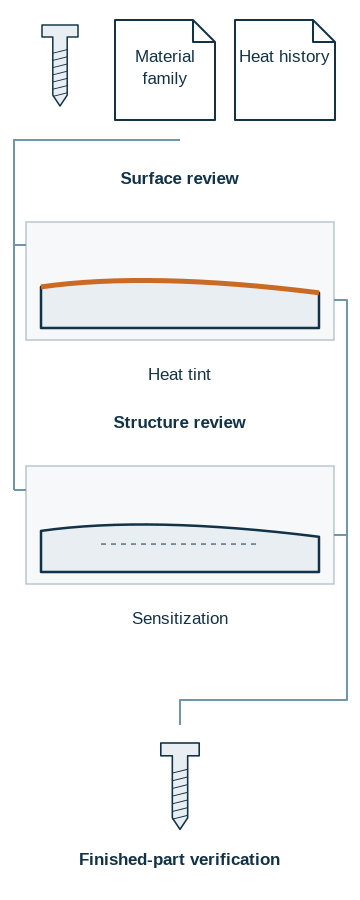
What changes during sensitization?
Under suitable temperature and time conditions, chromium-rich carbides can form at grain boundaries. Nearby regions then contain less chromium available to maintain corrosion resistance. This is a microscopic redistribution, not chromium disappearing from the entire screw. A susceptible structure may undergo intergranular attack when exposed to a suitable corrosive medium; sensitization and actual corrosion damage are therefore different findings.
Why is there no single safe heating recipe?
Sensitization depends on both the material and its thermal history, so a grade name cannot define one safe heating recipe. Carbon content, alloy design, prior cold work and the complete heating and cooling history influence the result. Welding nearby, hot forming and later furnace exposure can all contribute to that history. Low-carbon or stabilized grades can help control particular risks, but the grade name alone does not validate an unknown process. A record of actual part exposure, including repeated cycles, describes that history more fully than a furnace setpoint alone.
Is heat tint the same as sensitization?
Swipe the table sideways to compare every column. Keyboard: use the left and right arrow keys.
| Distinction | Interpretation |
|---|---|
| Surface versus grain-boundary condition | The thermal history can also change appearance, but that observation answers a different question. Heat tint is a visible oxide condition at the surface, whereas sensitization concerns the material near grain boundaries. |
| Evidence and corrective-action limits | They can arise during the same manufacturing history but require different evidence. Removing discoloration does not prove that the internal structure is suitable, and absence of discoloration does not establish a satisfactory thermal history. A corrective operation is meaningful only when its intended effect corresponds to the condition being investigated. |
This distinction matters for a screw with both a bright head and dark thread roots. The relevant surfaces include the recess and underside of the head wherever those areas will be exposed. A finishing operation selected only for the visible head can leave the functional surface condition unresolved. The acceptance specification therefore needs to connect final cleanliness with dimensional conformity, especially where material removal could affect thread fit.
The options on Special Coating Solutions for Stainless Steel Screws may be relevant to an identified surface condition. They should not be interpreted as a remedy for altered cold-work strength, an existing crack or a susceptible internal structure.
Separate manufacturing heat history from hot service
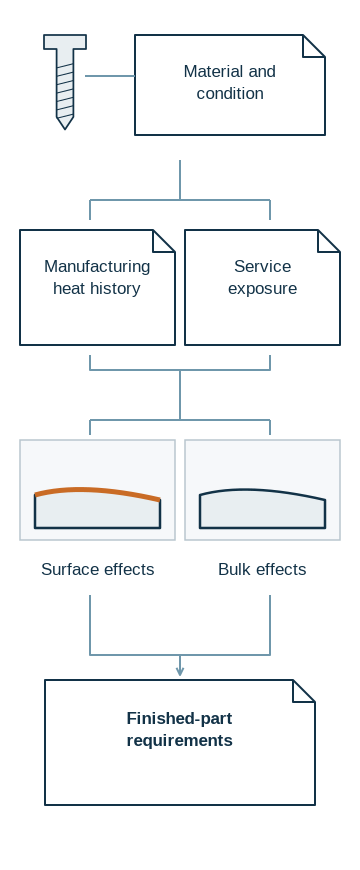
A manufacturing review asks what heat processing did to the material; a service review asks whether the loaded joint can perform over time. Grades developed for elevated-temperature service still need assessment of oxidation, creep and other properties against the intended duty. These related assessments cannot replace one another.
Can solution annealing restore a finished screw?
When the issue is manufacturing damage rather than a new service requirement, the repair must address the condition actually found. A suitable solution treatment can address certain microstructural conditions, but it is not a universal repair. Austenitic fasteners often obtain strength through cold work. Reheating may soften that condition, change dimensions or affect a coating and assembled components. Dissolving carbides does not heal existing cracks or replace material already lost to corrosion. A proposed repair must therefore meet the original mechanical and corrosion requirements together. 1
What should a rework review include?
Swipe the table sideways to compare every column. Keyboard: use the left and right arrow keys.
| Check | Required information |
|---|---|
| Product and original route | The exact grade, material heat, finished lot and original strengthening route establish which product is under review. |
| Proposed thermal sequence | The proposed heating, holding and cooling sequence describes the rework for the actual part geometry. |
| Separate conformity checks | Appropriate checks address intergranular corrosion susceptibility, mechanical properties and dimensional conformity as separate requirements. |
| Reference and final condition | Untreated reference pieces provide a comparison with the final reworked delivery condition, including any renewed surface treatment. |
A bright surface or an acceptable room-temperature tensile result does not, by itself, rule out sensitization. Agree the evidence before processing the whole lot, so improved appearance does not conceal a new strength or fit problem.
Use Quality & Testing for Stainless Steel Screws to agree the checks and record the combined rework decision for the same finished lot.
Thermal rework review record
- Product, grade, material heat and finished lot
- [ ]
- Original strengthening route and requirements
- [ ]
- Observed condition and actual heat history
- [ ]
- Proposed heating, holding and cooling sequence
- [ ]
- Reference and reworked sample identities
- [ ]
- Corrosion, mechanical and dimensional evidence
- [ ]
- Final surface condition and rework decision
- [ ]
Example: reviewing a proposed furnace rework
In a hypothetical batch of cold-worked 304 machine screws, a downstream heating operation causes discoloration and the buyer wants the original appearance restored. Material and property-class records, together with the actual heating history, provide the starting evidence. They support three separate questions: whether the surface needs treatment, whether the thermal exposure changed mechanical properties, and whether the microstructure needs corrosion-related investigation. A trial that addresses only color cannot close the other two questions.
After an agreed trial, a comparison of untreated and reworked pieces is meaningful when both are assessed against the same acceptance requirements. If the proposed route restores appearance but no longer meets the original strength requirement, it has not restored the specified product. A documented trial disposition gives the whole-lot approval a common basis for cosmetic recovery, metallurgical condition and finished-screw conformity.
Common questions
Can passivation reverse a damaging heat-treatment cycle?
No. Passivation is a surface treatment, not a reversal of the thermal cycle. Use the surface-versus-structure distinction to identify the concern, then apply the rework limits and verification record.
Reference Standards
These references describe standards and test methods within their stated scope. Listing a standard does not mean that a StainGrip product is certified to it or that a specific batch has passed a test.