
Preserve the failed parts and service history, then define which comparable connections need assessment. Keep recorded observations separate from the diagnosis.
Where can the necessary stress and environment come from?
Swipe the table sideways to compare every column. Keyboard: use the left and right arrow keys.
| Assessment input | What the source record should cover |
|---|---|
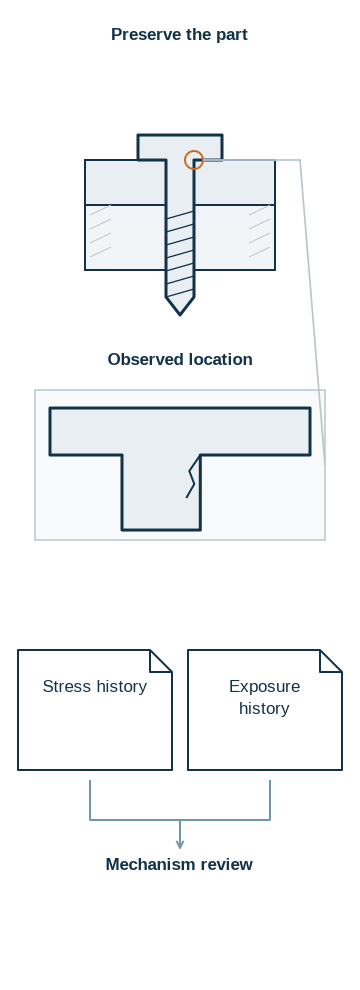
| Tensile stress | An SCC assessment concerns the stress and local exposure that could act together on the material. Tensile stress may come from the working load, bolt preload or residual stress left by manufacturing. |
| Local corrosive environment | The corrosive environment can be highly local: deposits, condensation and sheltered crevices may create conditions unlike the surrounding air. |
| Exposure record | A room humidity reading is therefore an incomplete exposure description. Cleaning practices, chemical sources, wetting and drying, temperature and contaminant-accumulation locations provide the additional context. |
Why are indoor pool connections a special example?
Indoor pool connections illustrate why that local-exposure description matters. Historical HSE guidance (SIM 5/2002/18) documents SCC in certain stainless components above indoor swimming pools, including failures involving common 304 and 316 materials. Deposits on components that are difficult to clean can become aggressive. This evidence should not be generalized into a claim that every stainless pool component will fail. It does show why an accessible, regularly washed fitting and a sheltered overhead support require different exposure assessments.
Does changing from 304 to 316 eliminate cracking risk?
This pool-hall evidence also limits what a routine grade upgrade can achieve. Resistance to staining or localized corrosion and resistance to a particular SCC environment are separate selection questions. BSSA advises against using ordinary 304 and 316 for vulnerable safety-critical load-bearing components in pool-hall atmospheres when these are not frequently washed or cleaned. Calling 316 marine grade does not override that application-specific concern. The relevant material decision must address the actual cracking environment.
The same investigation logic applies to a stainless screw. Whether the failed part is an austenitic product, a heat-treated martensitic product or another specified material affects the relevant mechanisms. An invoice description of stainless is too broad to justify combining unlike failures into one category. The alloy, strengthening route and service history determine which mechanisms deserve investigation and which replacement evidence is relevant.
Preserve evidence before diagnosing the failure
Swipe the table sideways to compare every column. Keyboard: use the left and right arrow keys.
| Evidence group | Purpose and limitation |
|---|---|
| Retained components and identity | Reliable material replacement and corrective decisions depend on evidence that distinguishes the possible causes. Both fracture halves, mating parts, batch identification and installation-orientation photographs contribute to that evidence. |
| Condition before cleaning | Polishing or aggressive cleaning before examination can change the fracture surface. |
| Service context and examination | Service duration, assembly history and changes in chemicals or maintenance provide context for the crack origins, fracture features, microstructure and deposits. |
| Alternative mechanisms and limits | Together, these findings allow consideration of fatigue, overload and manufacturing defects as alternatives. A rusty fracture or a shiny outside surface is not a diagnosis. |
Crack investigation handover record
- Connection, location and component identity
- [ ]
- Failed and retained mating-part references
- [ ]
- Material, batch and assembly history
- [ ]
- Crack location and original-condition photographs
- [ ]
- Load, chemicals, wetting and maintenance history
- [ ]
- Comparable positions and inspection findings
- [ ]
- Examination scope, unresolved causes and engineering disposition
- [ ]
Confirm the crack and connect it to service evidence
A line at a thread root may be a surface mark, lap, crack or viewing artifact. Record its position and orientation before examination. A qualified examination plan may use magnification, suitable surface methods and sectioning of selected retained pieces, but it must suit the material and geometry; convenience alone does not establish detection capability.
The relationship between the crack and service evidence is equally important. A defect already present in unused pieces suggests a different starting point from damage confined to particular wet installation locations. Neither observation is sufficient alone, but comparing them avoids diagnosing SCC from appearance only. Unaffected reference pieces from the same identifiable lot provide a useful basis for that comparison when they are available.
The requirements discussion on Quality & Testing for Stainless Steel Screws can help define product identity and the inspection evidence needed for an inquiry. It is not an SCC diagnosis or a qualification service for a safety-critical pool-hall support; the examination and joint assessment remain application-specific.
How should the rest of the joint be reviewed?
Swipe the table sideways to compare every column. Keyboard: use the left and right arrow keys.
| Review step | Evidence needed |
|---|---|
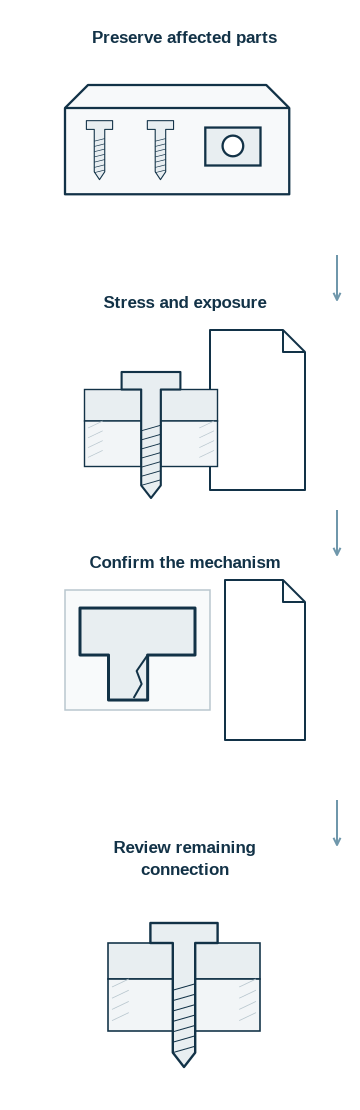
| Map comparable locations | The findings need to describe the affected population as well as one broken part. A map of affected positions and inspections at comparable locations can reveal the distribution, especially in inaccessible, sheltered or frequently wet areas. |
| Connections with shared exposure | A crack in one overhead load-bearing connection gives a reason to review nearby connections with the same exposure and design. |
| Inspection and replacement scope | The appropriate inspection method and replacement scope depend on access, geometry and failure consequences. Since visual checks may miss fine cracking, release of remaining parts requires evidence appropriate to the suspected damage. |
What changes can reduce recurrence?
Corrective action must address the demonstrated mechanism while preserving connection function. Assess material suitability, contaminant retention, drainage, cleaning access and stress together. Loosening a bolt can undermine clamping; a different stainless family needs exposure-specific justification. Coatings and insulating pieces also need review for durability, load transfer and trapped moisture.
For a screw specification inquiry after the relevant engineering assessment, Request a Stainless Steel Screw Quote and describe the confirmed material requirement, exposure, connection function and required evidence in the Message field. No catalog model is established here as suitable for the pool-hall or other SCC-sensitive example.
Example: cracking is limited to sheltered connections
In a hypothetical indoor installation, exposed stainless fittings remain sound while several sheltered upper connections crack. The paths reached by condensate and cleaning water offer an initial comparison between those positions. Material records, geometry, installation history and deposits from affected and unaffected locations provide further evidence. Together, these comparisons turn the apparent contradiction into a testable local-exposure question; the brighter fittings alone cannot establish alloy suitability everywhere.
The corrective plan should identify how future inspection will reach the critical interfaces and what event triggers reassessment, such as a changed cleaning chemical or new condensation pattern. Replacement alone closes the failed part; documented control of the demonstrated exposure and design problem is what addresses recurrence.
Common questions
Does an intact neighboring bolt prove the problem is isolated?
No. Neighboring parts may share the same exposure before showing visible damage. Their positions, material history and inspection findings provide a more useful basis for defining the affected population than the assumption that only the broken piece was involved.
Can a normal installation torque rule out SCC?
No. Installation torque is only one input. Actual tensile stress, residual stress and the local environment remain relevant to the mechanism and need appropriate evidence.
Will passivating the remaining screws remove an SCC problem?
Surface treatment cannot heal a crack or demonstrate that the remaining material is free from one. Repair selection therefore depends on the damage mechanism and affected population. If investigation identifies a specific aggressive exposure, the material, connection design and maintenance response need to address it. A cleaner appearance may be useful, but it does not resolve evidence about tensile stress, existing damage or continuing exposure. The resulting engineering decisions need a record separate from cosmetic restoration.
Reference sources
- Health and Safety Executive — Stress Corrosion Cracking of Stainless Steels in Swimming Pool Buildings, SIM 5/2002/18. Historical guidance issued 2 August 2002; the document lists a cancellation date of 2 August 2006. Original document hosted by BSSA.
- British Stainless Steel Association — Stainless steels for swimming pool building applications: selection, use and avoidance of stress corrosion cracking.
The historical HSE document is included for its recorded cases and context, not as a current regulation. These sources address particular exposure and component conditions; they do not establish suitability or compliance of a StainGrip product.