
Put both offers against one drawing and acceptance brief. Mark inclusions, exclusions and unresolved deviations before comparing delivered cost.
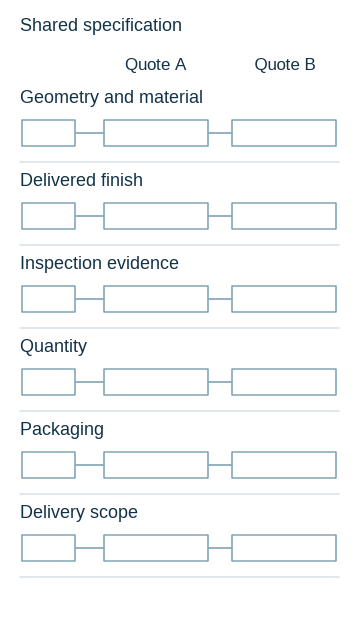
Make the technical specification comparable
Swipe the table sideways to compare every column. Keyboard: use the left and right arrow keys.
| Review item | What to check and how to interpret it |
|---|---|
| Geometry and configuration | A comparable specification identifies screw type, drawing or dimensional standard, thread and point, head and drive, length reference and application-critical tolerances. |
| Material and performance | “Stainless screw” alone identifies neither an alloy nor an agreed performance level. |
| Selection basis | Material choice involves corrosion resistance, strength, formability and availability; nickel content alone is not a quality ranking. |
An offer with an unspecified grade cannot yet be compared technically with one naming a grade. Wire-material descriptions likewise differ from requirements for the finished screw. A lower quotation may simply omit a condition included by another supplier; the price by itself cannot explain that difference. Clarification establishes whether the offers concern the same product.
Use the stainless steel screw catalog to identify a common product design before comparing grade, finish and evidence. The selected page is a starting point for a matching quotation, rather than proof that two offers contain the same specification.
Make the stainless requirement specific to the application
The application provides the reason for choosing stainless steel. For exposed assemblies, deposited salts, cleaning chemicals, trapped moisture and contact with other metals describe that reason more clearly than “best stainless.” A substitution must satisfy both exposure and mechanical function. Easier forming does not establish equivalent service performance, so an offered alternative grade needs technical review.
For an offered 410 screw, the required delivered condition is part of the comparison. Its material name cannot be treated as though it follows the same strengthening route as an austenitic screw. Type 410 is heat hardenable, so included thermal treatment and finished verification can affect the quoted scope. The supplier’s proposed route and acceptance evidence are more informative than an unqualified universal hardness value.
Define the delivered surface and evidence
Material and service requirements provide the basis for defining the delivered surface. Cleaning, passivation, electropolishing, coating and lubrication serve different purposes, so “bright finish” is an incomplete description. A quotation identifying the included operations, final condition and acceptance evidence allows meaningful comparison. Any resulting change in fit or assembly also belongs in the technical assessment.
Material certificates, mechanical reports and corrosion tests answer different questions. Their relevance depends on the identified lot, specimen condition, method and agreed criterion, not the number of pages. A report supports purchase acceptance when it verifies the ordered requirement; unrelated results do not establish batch conformity.
Resolve technical differences in a comparison table
A line-by-line scope comparison makes omissions visible.
Swipe the table sideways to compare every column. Keyboard: use the left and right arrow keys.
| Review item | What to check and how to interpret it |
|---|---|
| Technical evidence | Separate entries for material traceability, dimensions, specified mechanical tests, surface treatment, corrosion tests and application trials show what is included, excluded or unresolved. |
| Passivation evidence | For ASTM A967/A967M passivation, the agreed verification method defines more than an unspecified “passivation certificate.” The supplied result and its lot identity are part of that evidence requirement. 1 |
Drawing details can also explain price differences. Small changes in recess depth, point form or threaded length may need different tooling or produce different assembly behavior. A standard alternative offered by a supplier therefore needs its drawing and deviations reviewed before it can be considered a lower-priced version of the original item. Alternative approval and price comparison remain related but separate decisions.
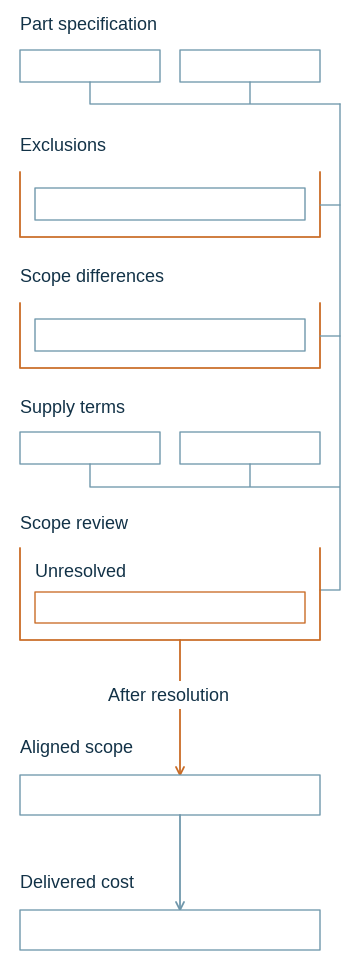
Quotation difference record
- Requirement
- [Drawing revision; material, inspection or other scope item]
- Offer A and offer B
- [Included, excluded or unresolved in each offer]
- Resolution
- [Deviation; responsible person; resolution date; agreed requirement]
- Repeat-order reference
- [Approved specification and purchase-order reference]
Complete one record for each unresolved difference before comparing unit prices. Keep the agreed specification with the purchase order for later repeat quotations.
Normalize quantity and delivery terms
Swipe the table sideways to compare every column. Keyboard: use the left and right arrow keys.
| Review item | What to check and how to interpret it |
|---|---|
| Common comparison basis | Resolved technical scope allows commercial terms to be compared on a common basis: quantity, packaging count, delivery point, currency, payment terms and quotation validity. |
| One-time charges | One-time tooling or development charges are separate cost items. |
| Order and shipment pattern | Initial orders, scheduled repeats and specially packed shipments may have different cost structures even when the screw itself is unchanged. |
The OEM screw and packaging requirements discussion can align pack count, labels and shipment format with the technical offer. Confirm the agreed scope and any separate charges in the quotation for the order.
Use actual performance to compare total cost
Equivalent deliverables and commercial terms provide the basis for total purchased cost. Relevant recorded sorting, rework, assembly-reject and disruption costs can then be included. Observed quantities and costs give that comparison stronger support than a supplier’s general savings claim. The method does not assume that the cheapest screw is unacceptable or that the most expensive must perform best.
A simple example of a comparable quotation
A simple example illustrates why scope precedes cost. Two hypothetical offers cover 50,000 stainless screws. Offer A includes the agreed surface treatment and lot report; offer B includes only cleaned screws and a general material statement. Their unit prices do not yet identify the cheaper way to meet the requirement. The gap can be resolved by pricing the missing items in B, or by revising the common specification if engineering finds those items unnecessary.
After the scope matches, the same delivered quantity and location provide a commercial comparison, while controlled sample trials reveal assembly differences. Additional handling or rework costs belong in the calculation only as measured values or explicit estimates with stated assumptions. The approved comparison retained with the order supports repeat buying, provided later material, treatment, packaging and delivery changes are reviewed against it.
Common questions
Is one stainless grade always a fixed percentage more expensive?
There is no fixed premium across dates, quantities and specifications. Contemporaneous quotations with equivalent requirements and terms provide a valid basis for comparison.
What information makes an RFQ easier to compare?
The drawing, intended substrate and exposure, quantity, required documents, packaging and delivery basis define a comparable RFQ. Explicit supplier deviations make differences visible before the order is accepted.
Reference Standards
These references describe standards and test methods within their stated scope. Listing a standard does not mean that a StainGrip product is certified to it or that a specific batch has passed a test.