
Request a quantity released for a defined period, with the calculation inputs attached. Use the repeat-order capacity record to check whether a quoted rate ends at headed blanks or includes finishing, inspection and packing.
Separate a part’s journey from a machine cycle
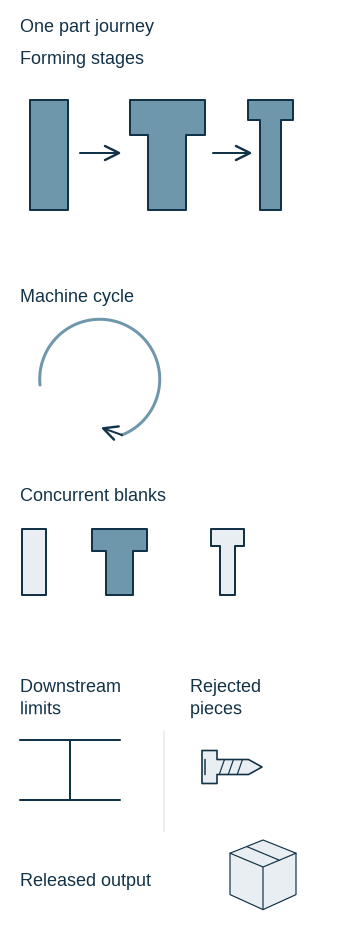
On a multistation former, different blanks can occupy different stages at the same time. Once the sequence is filled, a completed blank may leave during each working cycle even though each blank has undergone several operations. This overlapping flow explains why the number of operations per part is not the same as the number of cycles between discharged parts.
A speed quotation becomes comparable only when its basis is known: ram strokes, complete machine cycles or discharged blanks. Different architectures organize blows differently. A two-die, four-blow machine is a genuine equipment category, but the name alone does not give a speed directly comparable with every multistation machine.
Check what limits the intended screw
Swipe the table sideways to compare every column. Keyboard: use the left and right arrow keys.
| Review item | What to check and how to interpret it |
|---|---|
| Rate still needs evidence | Understanding the cycle does not yet establish the rate that a particular screw can sustain. |
| Part-specific limits | A short blank may be limited by transfer stability, a demanding recess by tool condition, and a large head by load distribution. |
| Combined process review | Process development considers forming sequence, transferability and tooling stresses together. |
| Value of extra stations | Additional stations help only when the resulting route solves the part’s actual constraints. |
Stable-rate observations are useful when they identify material condition and tool-life stage. A brief maximum-speed demonstration may omit interruptions that dominate an ordinary order. Accepted output, critical dimensions and any special handling over a representative run give a fuller picture of sustainable production.
Why stainless material can change the usable speed
Material is part of those constraints, especially for stainless screws. Austenitic wire may become harder to deform through successive operations. Extra stations distribute deformation, but their benefit depends on the preforms and contact conditions. The actual grade and delivered condition therefore belong with production data. Output from an easy-to-form reference material cannot establish the ordered stainless grade’s running rate.
Producing the shape is also distinct from achieving the delivery condition. A thermally hardened 410 screw route may depend on heat-treatment capacity and batch scheduling that the heading count does not show. An austenitic route can use a different forming and finishing sequence. Identical machine speeds consequently do not establish identical shipment dates without a comparison of the complete routes.
Turn running output into accepted output
Swipe the table sideways to compare every column. Keyboard: use the left and right arrow keys.
| Calculation item | Value and meaning |
|---|---|
| Calculation basis | Accepted heading output can be calculated once the usable rate and its material basis are defined. |
| Assumed rate, time and yield | An illustrative model uses one blank per cycle, 100 cycles per minute, 240 running minutes and a 98% acceptance yield. |
| Accepted headed blanks | Accepted headed blanks equal 100 × 240 × 0.98 = 23,520. |
| Example limitation | These assumptions explain the calculation rather than demonstrate a supplier’s capacity. |
If the scheduled window was 300 minutes, actual runtime has already excluded the other 60 minutes; subtracting that downtime again would count the loss twice. Comparable records also need a consistent treatment of setup, material changes, maintenance, tool changes and rejected startup pieces within the scheduled window.
Identify the downstream stage that controls delivery
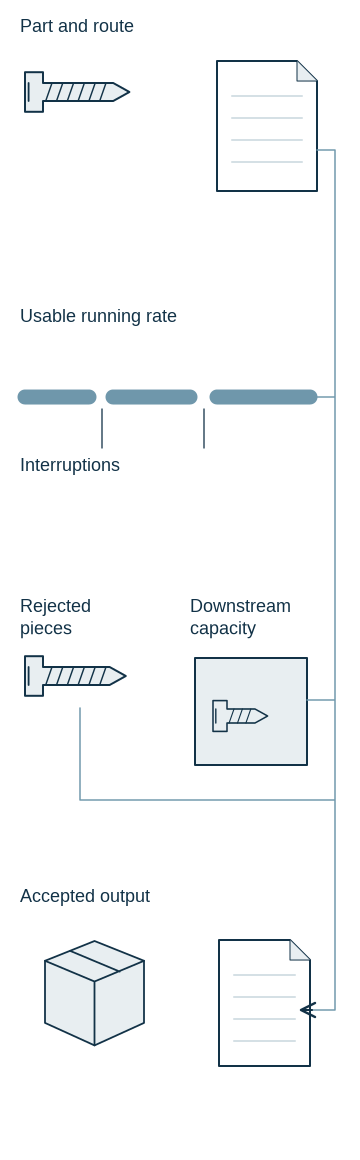
The calculation ends with headed blanks, whereas the order calls for finished screws. Thread production, treatment, inspection, packaging or outsourced work may control delivery. A plan that identifies the controlling stage and accounts for its capacity connects the heading figure to the quantity and condition the buyer actually needs.
The quality and testing requirements for the order help define what must be checked before finished quantity is released. Inspection requirements and accepted condition belong in the delivery plan alongside each production stage.
Extend the capacity example through final release
Swipe the table sideways to compare every column. Keyboard: use the left and right arrow keys.
| Calculation item | Value and meaning |
|---|---|
| Stage distinction | Extending the same example shows the difference between heading output and final release. |
| Subsequent yield calculation | From 23,520 accepted headed blanks, an assumed combined acceptance yield of 97% in subsequent operations gives 23,520 × 0.97 = 22,814.4 pieces, or about 22,814 whole screws. |
| Fractional-result limitation | The fraction is a model expectation, not a possible physical shipment. |
| Actual release basis | Actual release uses the counted quantity that has passed the required checks. |
Yield and time capacity answer different questions. Even with that yield, a downstream inspection stage able to release only 20,000 screws in the same planning window would limit released output to that smaller quantity unless capacity or the window changes. These hypothetical numbers illustrate why a buyer needs both conversion losses and stage capacity, rather than simply multiplying the header speed by the order’s available hours.
Request capacity evidence for the repeat order
Swipe the table sideways to compare every column. Keyboard: use the left and right arrow keys.
| Planning input | Evidence or entry to request |
|---|---|
| Product and run basis | [Drawing/revision; material condition; included operations; development trial or established repeat run]. Identify the product and conditions represented. |
| Rate definition | [Ram strokes, machine cycles or discharged blanks; stable rate; supporting run record]. Use the same basis in the comparison. |
| Time and quantity | [Production period; scheduled window; actual runtime; interruptions; gross, rejected and accepted quantities]. Keep the treatment of downtime and startup pieces consistent. |
| Downstream release | [Threading/treatment/inspection/packing or outsourced stages; accepted quantities; controlling stage]. Identify where the plan reaches finished screws. |
| Shared resources | [Finishing/inspection resource; time allocated to this order; competing allocation or unresolved constraint]. Available equipment is not the same as assigned capacity. |
| Changes and evidence gaps | [Changed head, recess, material or route; relevant trial reference; assumptions still unverified]. Do not treat historical output as automatic approval of a different screw. |
For a stainless screw with a revised head, recess or material condition, earlier output remains a reference rather than automatic validation. The changed constraint needs a relevant trial, and its stable output becomes the basis for the updated delivery calculation. This prevents historical production from becoming an unsupported commitment for a technically different screw even when nominal diameter and length remain unchanged.
Provide quantity, packaging and delivery pattern in the OEM screw and packaging requirements discussion so that the plan addresses the actual order. The illustrative output figures in this article are not a statement of StainGrip capacity or a delivery commitment.
Common questions
Can I use output from a similar screw for delivery planning?
Output from a similar screw can support an initial estimate when the differences are identified, but it does not validate the new product. Material, geometry, tooling and downstream operations may change accepted output, so a delivery commitment needs evidence addressing those differences.
Should rejected parts be counted as production?
They can appear in the gross output record, but must be separated from accepted output. Recording both values makes quality losses visible and prevents a high machine count from being mistaken for the quantity available to ship.