
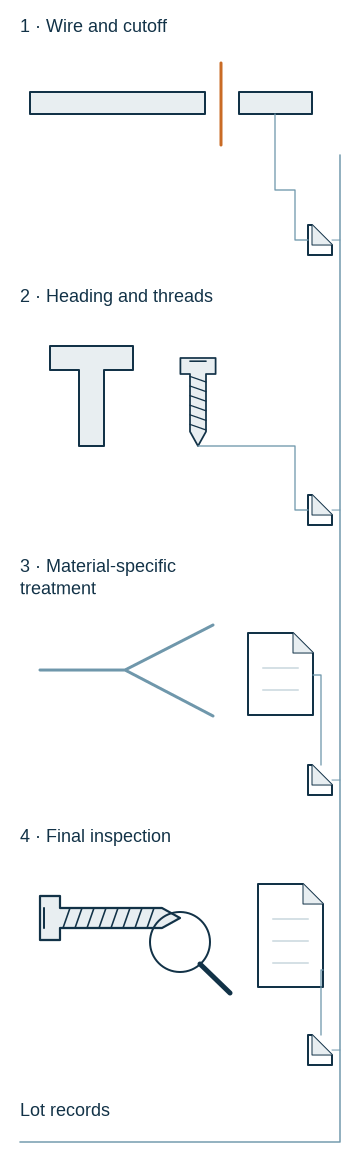
Ask the supplier to mark the actual route, including outsourced stages. The batch route record links the drawing, coil, process checks and final release without assuming every operation is performed in-house.
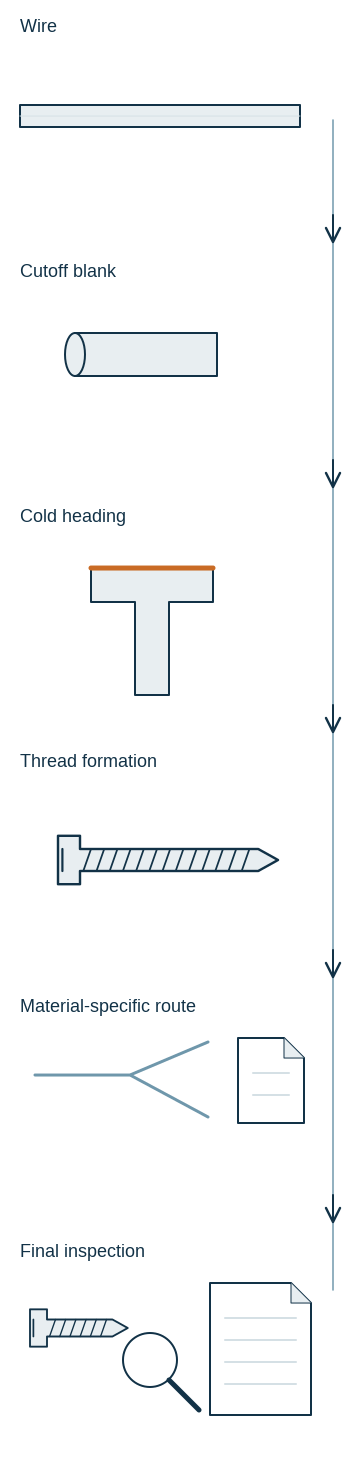
Wire and cutoff establish the starting condition
Swipe the table sideways to compare every column. Keyboard: use the left and right arrow keys.
| Review item | What to check and how to interpret it |
|---|---|
| Wire suitability | The wire must have an appropriate grade, diameter, surface condition and forming response for the intended product. |
| Feeding and straightening | Feeding and straightening prepare it for consistent cutoff. |
| Operation distinction | Straightening improves the wire’s path and straightness; it is not the same operation as drawing through a die to reduce diameter. |
Cutoff determines the metal supplied to the blank. Variations in length, end condition or seating can affect later fill and alignment. Wire-heat and production-lot records established at this stage connect an investigation of a finished screw to the actual incoming material.
Heading creates shape by moving metal
The prepared cutoff blank supplies the metal redistributed during heading. Dies and punches guide plastic flow to form the head and assigned shank features. Upsetting gathers material, while extrusion moves it into a smaller section or another required form; intermediate shapes distribute the deformation. Inspection at the forming stage relates head fill, folds, cracks and head-to-shank alignment to the operation creating them.
Cold forming can reduce cutting waste, but the complete route still has startup pieces, rejects and potentially trim or machining stock. It also changes the material through cold work. Neither “no waste” nor “unchanged material properties” is a useful blanket description of screw heading.
To distinguish forming stages from accepted output, see whether more cold-heading stations mean more screw production.
Map the route to the stainless material family
Heading changes material condition as well as shape, so the later route depends on the stainless family. In an austenitic screw, cold work contributes to final condition and later annealing may change it. A 410 screw requiring thermal hardening instead needs a defined hardening and tempering stage with subsequent inspection. Similar-looking finished screws can therefore have different checkpoints. “Stainless” alone neither determines the route nor establishes delivered mechanical properties.
Swipe the table sideways to compare every column. Keyboard: use the left and right arrow keys.
| Review item | What to check and how to interpret it |
|---|---|
| Different records | This distinction also explains why different certificates are needed. |
| Input, operation and finished result | Wire chemistry identifies an input, a heat-treatment record documents an operation, and a finished mechanical test addresses a product requirement. |
| Connection to the order | Their value lies in connecting the ordered screw to its actual route. |
| Representative test condition | A test sample must represent the condition after the operations relevant to the property being accepted. |
The OEM screw and packaging requirements discussion starts with the required part and delivery condition, which define the route to be assessed. It does not establish that every operation described here is required for a specific screw or performed in-house.
Threads and final condition complete different requirements
The selected material route works alongside operations that complete the screw’s function. Threads may be rolled or cut, and particular designs may also need machining, cleaning or surface treatment. The position of a thermal step depends on the required material condition, rather than following one universal sequence for every stainless screw.
A tapping, wood or self-drilling screw also interacts with its intended substrate. Calling it a metric machine screw does not describe its thread and point functions. The relevant geometry and application requirements in the order provide the basis for verification appropriate to the actual product.
Distinguish forming aids from the delivered finish
Thread and point completion leaves the delivered surface as a separate requirement. Wire coatings and lubricants may assist deformation, while the delivery specification determines unwanted residues and any required passivation, additional coating or controlled lubrication. ASTM A967/A967M concerns chemical passivation and alternative verification methods, not thread geometry or screw load capacity. Each requirement therefore needs the operation and evidence that address its own purpose. 1
Handling after finishing preserves both lot identity and the accepted surface through appropriate containers, labeling and separation. Coating or lubrication added after an earlier dimensional or assembly check may change whether that result represents the delivered part. A complete process flow therefore ends with the condition reaching the customer, rather than merely the last shape-forming operation.
Connect the process stages through inspection and batch records
Swipe the table sideways to compare every column. Keyboard: use the left and right arrow keys.
| Checkpoint | Requirement and evidence to record |
|---|---|
| Order and route definition | [Part/drawing revision; material, drive-fit and final-surface requirements; route reference; batch ID]. Identify the inspection points for the actual order. |
| Incoming material | [Coil/heat ID; ordered material requirement; incoming inspection/document reference]. Connect the coil to the screw lot. |
| Heading | [Head/recess requirement; forming-stage sample or measurement record; tooling reference; disposition of defects]. Check while the tooling is available for correction. |
| Thread production | [Profile and fit requirement; applicable measurement/gauge record; lot reference]. |
| Final inspection and release | [Delivered dimensions; required performance and surface evidence after finishing; accepted quantity; report/sample references]. Identify any outsourced stage and its returned-lot link. |
If outsourced treatment splits a lot into returned portions, keep their identities and reconcile quantities before repacking. Separate rejected or reworked portions from released stock. Records must follow the material across company boundaries; one company need not perform every operation.
Final visual sorting can identify observable defects, but cannot replace controls for internal integrity or mechanical properties that appearance does not reveal. Connect the quality and testing requirements, sample review and documents to the lot and tested condition, covering material, dimensions and threads, drive engagement and specified performance.
Common questions
Does a process flowchart prove that a batch passed inspection?
No. A flowchart describes the intended route, whereas batch records show the material, operations and completed checks. The records give the flowchart its batch-specific evidence; the chart alone does not demonstrate a successful test.
When should an outsourced operation be included in traceability?
An outsourced operation belongs in traceability whenever it contributes to ordered product condition or verification. The links among outgoing batch, service performed, returned batch and acceptance evidence make the route understandable across company boundaries.
Reference Standards
These references describe standards and test methods within their stated scope. Listing a standard does not mean that a StainGrip product is certified to it or that a specific batch has passed a test.