
Define the minimum screw-metal temperature and complete operating cycle. Use the specification record to connect the supplied condition with the required joint function.
Define the minimum metal temperature and service cycle
Swipe the table sideways to compare every column. Keyboard: use the left and right arrow keys.
| Service descriptor | Meaning for the fastener |
|---|---|
| Design minimum | The relevant minimum is the lowest temperature that the fastener metal is expected to reach, including startup, shutdown and abnormal conditions covered by the design. |
| Different cold duties | A cold room operating at −40 °C is a different duty from equipment exposed to liquid nitrogen, whose normal boiling point is approximately −196 °C. |
| Metal temperature and duration | Fluid temperature helps describe exposure, but the screw-metal temperature and its duration define the fastener’s own thermal condition. |
The number and speed of temperature changes, condensation, cleaning chemicals and access to the connection complete that service description. These details identify the conditions that qualification needs to represent; the word cold alone leaves them open to interpretation.
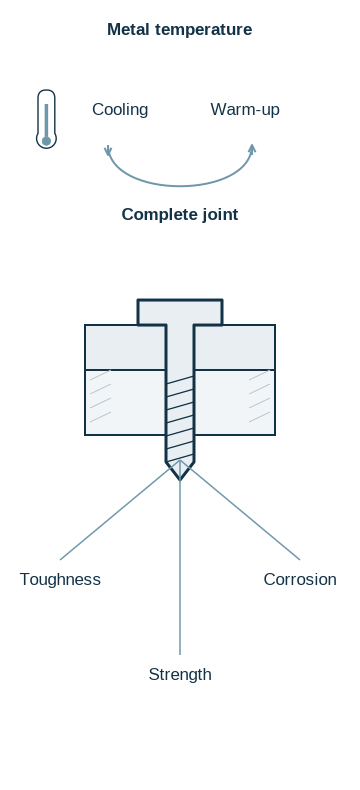
What does the material family tell you?
With the cold duty defined, the material family provides a starting point for selection. Austenitic stainless steels do not show the same pronounced ductile-to-brittle impact transition as many ferritic and martensitic steels. However, cold working and the resulting microstructure can change toughness, and welds introduce another material condition. A datasheet for annealed plate is therefore useful background, but it cannot automatically represent a heavily cold-worked screw from an unidentified batch.
Why are toughness, strength and corrosion separate decisions?
Swipe the table sideways to compare every column. Keyboard: use the left and right arrow keys.
| Performance question | Required distinction |
|---|---|
| Tensile load and notch or impact response | The material-family advantage needs to be connected to the particular property required. A material can resist a high tensile load while still needing separate evidence for its response to a notch or impact at the design temperature. |
| Finished mechanical condition | For cold-worked stainless screws, the finished mechanical condition is part of that evidence. |
| Corrosion-related grade choice | Choosing 316 instead of 304 may address a corrosion concern, but the grade change does not by itself establish a required impact result. Separate performance requirements in the order prevent these different questions from being conflated. |
Martensitic 410 has a heat-treatable structure whose finished condition needs its own low-temperature assessment; the assumption that all stainless steels behave alike does not justify substitution. Tapping and drilling screws also require evidence for both material suitability and connection function. An alloy suited to the cold environment does not automatically establish penetration or thread-holding performance in the actual substrate.
What does the property class prove?
ISO 3506-1 defines specified properties verified at ambient test temperatures for stainless machine screws with ISO metric threads within its scope. It does not give wood, self-tapping or self-drilling screws a general temperature rating. For cold service, link the material certificate, finished condition and relevant temperature evidence to the same product lot; a room-temperature result or general alloy brochure cannot establish the operating envelope. 1

What changes during cooling and warm-up?
Swipe the table sideways to compare every column. Keyboard: use the left and right arrow keys.
| Joint feature | Assessment and limits |
|---|---|
| Relative contraction | Material evidence alone leaves the behavior of the assembled connection unresolved. Different components can contract by different amounts. |
| Effect on load and sealing | Depending on the relative materials, temperatures and joint stiffness, this can change the screw load or seal compression. |
| Complete stack and spacers | The complete stack determines that response; colder conditions do not necessarily increase or necessarily reduce clamping. Insulating spacers are part of the same assessment because their behavior and compression also influence the connection. |
The same service cycle has an environmental side as well as a dimensional one. Warming can introduce a separate corrosion exposure when moisture condenses on the cold assembly. Cleaning residues and salts retained at the screw contact should therefore be included in the environment description. A cold-service qualification focused only on minimum temperature may miss the wet conditions during maintenance or defrosting. Drainage and cleaning access remain useful even when the main design question concerns toughness.
Combine the evidence into a connection qualification
Qualify the complete connection: screw, engaged threads, clamped components, seals and assembly procedure. Any required impact or other low-temperature test needs representative specimens and agreed criteria suited to the product. Small screws may not provide a standard impact specimen, so agree an evidence route instead of inventing test values.
Use Quality & Testing for Stainless Steel Screws to discuss evidence for the actual cold-service connection, including the supplied material condition and the agreed test purpose. The general inspection page does not establish a low-temperature rating for any catalog screw.
For a project-specific review, Request a Stainless Steel Screw Quote and describe the minimum screw-metal temperature, service cycle, substrate, engagement and required function in the Message field. A grade name alone leaves those qualification conditions unresolved.
Cold-service specification record
- Screw, drawing revision, material and finished condition
- [ ]
- Minimum screw-metal temperature and duration
- [ ]
- Cooling, warm-up and cleaning cycles
- [ ]
- Joint load, engagement, mating parts and seals
- [ ]
- Required function and acceptance criteria
- [ ]
- Representative specimen and test purpose
- [ ]
- Lot-linked evidence and qualification limits
- [ ]
Example: defining a refrigerated enclosure screw requirement
For a hypothetical refrigerated enclosure, the minimum screw-metal temperature and the temperature reached during cleaning define the thermal starting point. Some screws may retain only a cover, while others maintain a loaded or sealed connection. The same nominal material can therefore face different evidence requirements at different positions. Substrate, engagement, seal and assembly details make the assessment specific to the real connection rather than an isolated catalog screw.
An agreed test needs a defined purpose before specimen selection: material toughness, low-temperature joint function or retained sealing. The specimen condition and its traceable relationship to supplied parts determine which decision the result can support. A satisfactory outcome for that purpose does not establish every cold-service property.
Common questions
Can a higher strength class replace low-temperature evidence?
No. Strength class and low-temperature suitability answer different questions. The required evidence must still represent the temperature and finished material state.
Is every outdoor installation a cryogenic application?
No. The actual minimum metal temperature and exposure cycle define the application. Deep-cryogenic assumptions do not automatically apply to a mild-weather joint, and mild-weather evidence does not qualify deep-cryogenic service.
Should cold-service screws be tested only after cooling?
The service requirement determines the test stages. Repeated cooling and warming may require evidence both at the cold condition and after the agreed cycle. Define the temperature path, load and acceptance purpose: material toughness, leakage, screw integrity and retained clamping are different targets, and one passing result does not establish the others.
Reference Standards
These references describe standards and test methods within their stated scope. Listing a standard does not mean that a StainGrip product is certified to it or that a specific batch has passed a test.