
Stop increasing driving input when resistance rises unexpectedly. Preserve both mating parts and record the engagement stage, lubricant and tool settings before changing the process.
Preserve the paired parts and the sequence
If resistance rises unexpectedly, stop increasing driving input to limit further damage and record whether the head has seated. Preserve the screw with its mating nut or threaded component. Record the tool, speed, surface treatment, lubricant and previous use, plus how the pair was removed: forcing or cutting it apart may alter the evidence. Keep unused parts from the same lot for comparison.
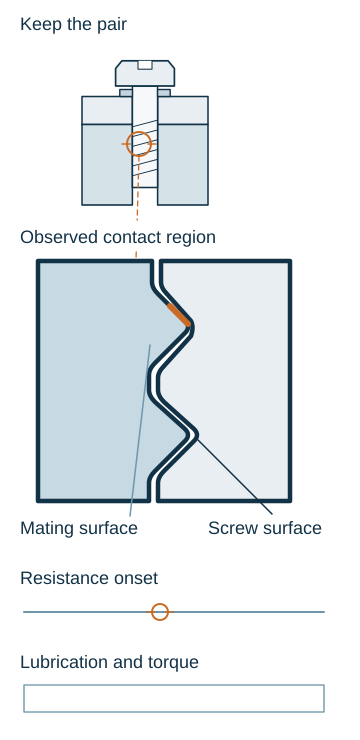
Recognize galling without labeling every jam as galling
The retained pair allows the failure mechanism to be examined instead of inferred from a stuck screw alone. Galling involves adhesive damage at loaded sliding contacts. Transferred or torn material on either member of the thread pair provides relevant evidence, as do an angled start, damaged leading threads and foreign matter. Initial resistance before normal engagement may point toward a different problem from seizure after substantial rundown. A stainless material designation does not by itself establish either the presence or absence of galling in an individual assembly.
Entry resistance in a plastic or composite panel needs a different investigation. See why a self-tapping screw may not start in plastic or composite before treating every installation jam as galling.
Use the resistance pattern to choose the next check
The physical findings become more informative when linked to the recorded installation sequence, including engagement before final tightening.
Swipe the table sideways to compare every column. Keyboard: use the left and right arrow keys.
| Recorded resistance pattern | Next investigation target |
|---|---|
| From the first turn | Consistent resistance from the first turn makes alignment, thread identity and entry damage relevant investigation targets. |
| After initially normal engagement | A sudden rise after initially normal engagement directs attention to both mating surfaces and assembly history. |
| At a repeatable depth | Resistance at a repeatable depth can justify examination for bottoming or obstruction. |
These are diagnostic leads, not proof of cause. A torque history linked to screw position provides more information than the final peak torque alone.
The actual contact system determines how that evidence is interpreted. A stainless machine screw in a stainless tapped component differs from a stainless tapping screw that is deliberately creating a thread. Cutting or forming resistance is expected in the latter case and is not automatically evidence of galling. The record therefore needs to identify whether a prepared mating thread existed and whether the event occurred during thread creation, rundown or final clamping.
Select a compatible and controlled lubrication condition
Swipe the table sideways to compare every column. Keyboard: use the left and right arrow keys.
| Control point | Requirement and limits |
|---|---|
| Treatment and compatibility | When the investigation supports friction control, a clearly defined treatment makes corrective trials comparable. Oil, wax, an anti-seize compound or a suitable surface treatment may be part of a mitigation strategy. Selection depends on the actual materials, service temperature, cleanliness requirements and downstream processes. |
| Limits of the treatment | The treatment does not increase the screw’s underlying strength or guarantee freedom from galling. |
| Delivered and added material | For a prelubricated product, a defined delivery condition and control of any material added during assembly prevent uncontrolled differences between operators or trials. |
If a controlled surface condition is being considered, Special Coating Solutions for Stainless Steel Screws provides the published options for discussion. No listed treatment should be assumed to eliminate galling or to leave the previous tightening setting valid.
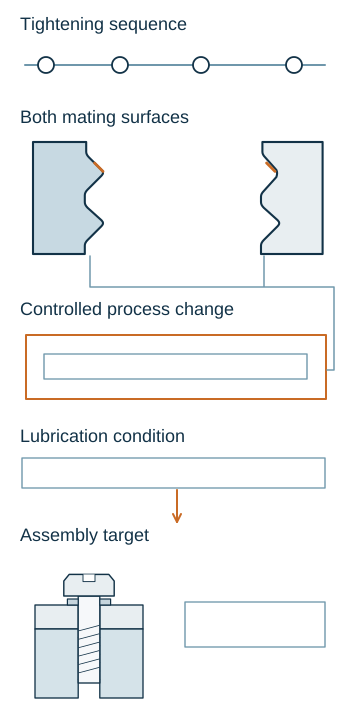
Reassess torque when friction changes
That treatment changes more than the ease of turning. Lower friction can produce a higher preload at the same applied tightening torque. Reusing a dry-joint setting after adding lubricant may therefore overload the screw, internal thread or clamped material. The revised process needs a review of the required clamp-force range and validation of the torque–preload relationship with the actual mating parts. A generic percentage reduction is not a substitute for that work, and easier turning is not evidence that the final joint load is acceptable.
Use Quality & Testing for Stainless Steel Screws to discuss verification of the actual mating components and required clamping after a friction change. The trial needs a defined assembly target rather than a generic torque reduction.
Example: a lubricant trial with a controlled assembly target
In a hypothetical assembly, a stainless screw and tapped stainless housing repeatedly seize before the head seats. Retained damaged pairs and conformity and cleanliness checks on unused components provide an initial basis for a trial. The trial could compare the original delivered condition with a specified lubricant on otherwise matched parts, using a controlled application method. Separate records of seizure, rundown behavior and the final connection result would distinguish the outcomes. Smooth turning in the lubricated group would support further evaluation of friction control without yet establishing a safe final tightening setting.
A complete trial verifies the required clamping and, where the qualification plan requires it, examines damage after disassembly. Records of the exact lubricant, application location, delivered screw finish and mating-part identity make a successful result reproducible on the next lot. A later substitution of lubricant, cleaning process or mating material changes that documented basis and calls for review of the affected conditions. It is not an inconsequential purchasing change.
Keep the whole assembly process consistent
Swipe the table sideways to compare every column. Keyboard: use the left and right arrow keys.
| Production control | What remains necessary |
|---|---|
| Consistent process inputs | A successful trial becomes useful only if production preserves the evaluated combination. Thread conformity, cleanliness, mating material, lubricant application, tool alignment and tightening strategy therefore need coordinated control. |
| Representative alternative-process trial | Repeated damage during high-speed or impact assembly can justify an alternative-process trial on representative joints; no single speed suits every size and material pair. |
| Acceptance and damaged parts | Acceptance needs evidence of galling occurrence and achieved clamp function, together with a defined disposition for damaged parts. New lubricant on an already galled pair cannot restore its original geometry or establish suitability for reuse. |
Common questions
Does changing only the screw solve a seized thread pair?
Not necessarily. The internal thread may also contain transferred material or torn flanks. Reassembly needs an assessment of the mating component against documented replacement or repair criteria. A fresh screw entering a damaged hole does not establish that the original fit, load capacity or friction condition has been restored.
Will changing only from 304 to 316 eliminate galling?
A corrosion-grade change is not a verified galling remedy by itself. The mating material, finish, thread condition and assembly process remain important. The proposed pair needs evaluation under the intended conditions, with a recorded reason for the change. A new alloy number alone cannot establish improved resistance to seizure.
Is a thread that has been forced free ready for reuse?
Free rotation after removal does not restore torn or transferred material. Both components need assessment against the applicable reuse or repair criteria. Where the thread condition cannot be established, replacing only the visible screw may leave a damaged mating thread in the assembly.