
Record metal temperatures, time, load and thermal cycles for the complete connection. Match supporting data to the actual screw and supplied condition.
Define temperature, duration and thermal cycling
A short heating event and continuous operation for months are different duties, even if their peak temperatures match. The exposure profile consists of normal metal temperature, occasional peaks, time at each condition and planned service duration. Startup and shutdown cycles, together with temperature differences between the fastener and clamped parts, complete that description. Evidence that represents this profile is more useful than the highest number printed in a datasheet.
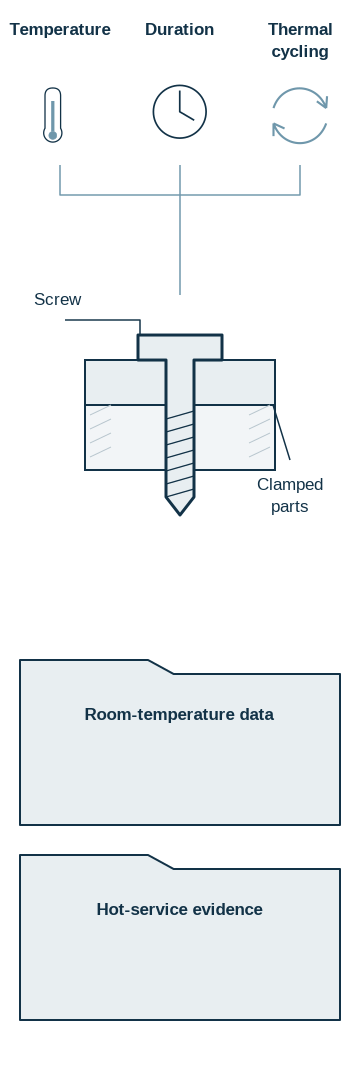
Which high-temperature properties are different?
The exposure profile determines which properties need assessment.
Swipe the table sideways to compare every column. Keyboard: use the left and right arrow keys.
| Property | What it describes |
|---|---|
| Oxidation resistance | Reaction with the hot environment. |
| Elevated-temperature strength | Load capacity at the specified temperature. |
| Creep | Time-dependent deformation under sustained stress. |
| Stress relaxation | Reduction of stress under constrained deformation. |
In a joint, these mechanisms can influence retained clamping. A surface that remains visually sound can coexist with a loss of the mechanical margin needed for service.
Why can thermal expansion change screw clamping?
Swipe the table sideways to compare every column. Keyboard: use the left and right arrow keys.
| Joint detail | Why it belongs in the assessment |
|---|---|
| Relative expansion | These material mechanisms operate within a joint whose dimensions also change during heating. The screw and clamped stack may differ in material, length and temperature. Their relative expansion can change the screw load; the direction and amount depend on the joint configuration. |
| Compressible layers | Gaskets or other compressible layers add their own response. |
| Actual stack and sequence | The actual stack and heating sequence therefore determine the assessment, rather than a single expansion factor applied to the whole assembly. |
The assembly condition is another part of that thermal response. A lubricant or coating chosen for room-temperature installation may not retain the same properties after heating. Repeated thermal cycling can expose a connection to changing clamping, movement and surface conditions. A useful specification consequently describes both how the joint is assembled and the function it must maintain through the planned operating cycle.
Check what the room-temperature class actually covers
The required behavior determines whether the available marking and documents provide relevant evidence. For stainless machine screws with ISO metric threads within its scope, ISO 3506-1 evaluates specified properties at ambient test temperatures. A wood, self-tapping or self-drilling screw needs its own applicable product and connection evidence. The room-temperature class does not guarantee the same properties at every service temperature. Likewise, a blanket claim that ordinary 304 or 316 is always acceptable below one temperature and unacceptable above it omits essential application conditions. The chosen specification, suitable temperature-dependent data and joint analysis need to support the same duty. 1
Is there a dedicated standard for high-temperature fasteners?
A dedicated high-temperature specification may be relevant where the product fits its scope. ISO 3506-5:2022 addresses specified special fasteners made from certain corrosion-resistant stainless steels and nickel alloys for high-temperature applications. It is a separate framework from an A2 or A4 head mark. Its existence does not assign its upper scope temperature to every stainless screw. Inclusion in a purchase specification therefore depends on whether the exact alloy, product geometry and required tests fit that framework. 2
For ordinary cold-worked 304 or 316 screws, elevated-temperature data need a clear connection to the proposed duty and supplied condition. For heat-treated 410, the hardening and tempering condition is part of that connection. A material name without its processing state can conceal important differences when the joint remains hot under load.
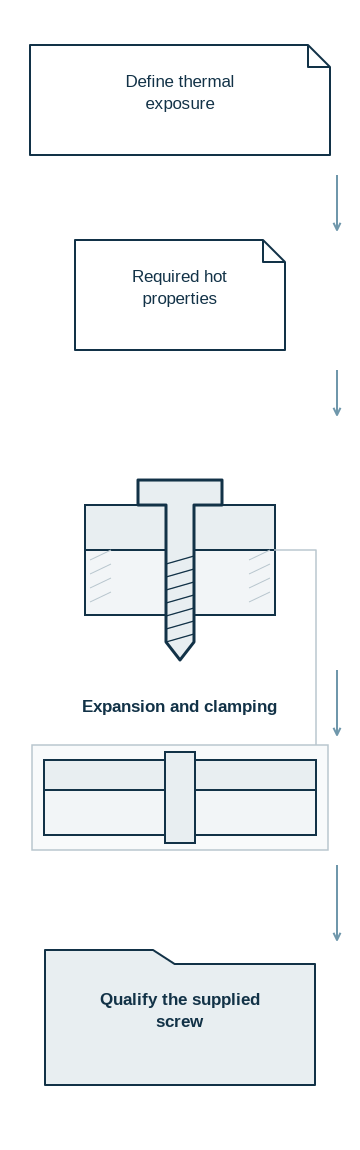
Connect material data to the supplied screw
Whether a dedicated standard or supporting material data are proposed, their relevance depends on the exact grade, product form and delivery condition. A typical measured value, guaranteed minimum and design allowable also serve different purposes. For example, material data for 304H address high-temperature creep-related duties; such data do not certify an ordinary 304 screw or make those two finished products interchangeable. Data for plate, strip or another product form need a justified connection to the fastener being ordered.
Use Quality & Testing for Stainless Steel Screws to discuss how proposed evidence will be linked to the supplied screw condition and intended duty. A general testing page does not establish hot-service certification or a temperature limit for a catalog model.
What belongs in a hot-service inquiry?
Swipe the table sideways to compare every column. Keyboard: use the left and right arrow keys.
| Check | Required information |
|---|---|
| Joint and load | A drawing and the joint’s load and clamping requirements. |
| Temperature profile | Normal and peak metal temperatures, durations and cycling conditions. |
| Exposure chemistry | The environment, including gases, liquids and possible deposits. |
| Material and finished condition | The exact material and finished condition, with required temperature evidence. |
| Mating parts and assembly | Mating-part, surface-treatment and assembly requirements that remain valid at temperature. |
Specify the complete connection: a stronger hot-service alloy cannot compensate for a seal, nut or assembly method that fails the duty.
Use Request a Stainless Steel Screw Quote to describe the operating conditions. No catalog-wide maximum service temperature is established.
Hot-service inquiry record
- Screw, drawing revision, material and supplied condition
- [ ]
- Normal and peak metal temperatures
- [ ]
- Time at temperature and thermal cycles
- [ ]
- Joint load and required clamping or sealing function
- [ ]
- Mating materials, surface treatments and assembly
- [ ]
- Gases, liquids or deposits
- [ ]
- Applicable evidence, acceptance criteria and operating limits
- [ ]
Example: a hot cover screw has more than one temperature
In a hypothetical process enclosure, the inside gas temperature is much higher than the measured outside cover temperature, and the screw bridges regions with different exposure. The expected metal temperatures along the connection, cover load and sealing requirement provide a basis for separate assessments of normal operation and shutdown. Depending on the heat path, gas temperature alone may overstate or understate the relevant fastener condition.
A useful trial answers the unresolved question, such as retained clamping after the agreed cycles, rather than merely showing that the screws remain shiny. Test conditions and acceptance requirements linked to the material records document the basis for the decision. If later operation raises the temperature or extends time at temperature, that record makes the need for reassessment clear.
Common questions
Can a screw be reused after an unexpected overheating event?
Cooling back to room temperature does not demonstrate that the original properties and clamping condition have been restored. Peak metal temperature, exposure duration, load and visible deformation describe the event for comparison with permitted operating conditions and available material evidence. The original delivery certificate describes the supplied condition; it does not certify the condition after an unqualified thermal event. Continued use or replacement therefore depends on the applicable joint assessment and any examination it requires. 1
Reference Standards
- ISO 3506-1:2020 — Mechanical properties of stainless steel bolts, screws and studs
- ISO 3506-5:2022 — Special fasteners for high temperature applications
These references describe standards and test methods within their stated scope. Listing a standard does not mean that a StainGrip product is certified to it or that a specific batch has passed a test.